
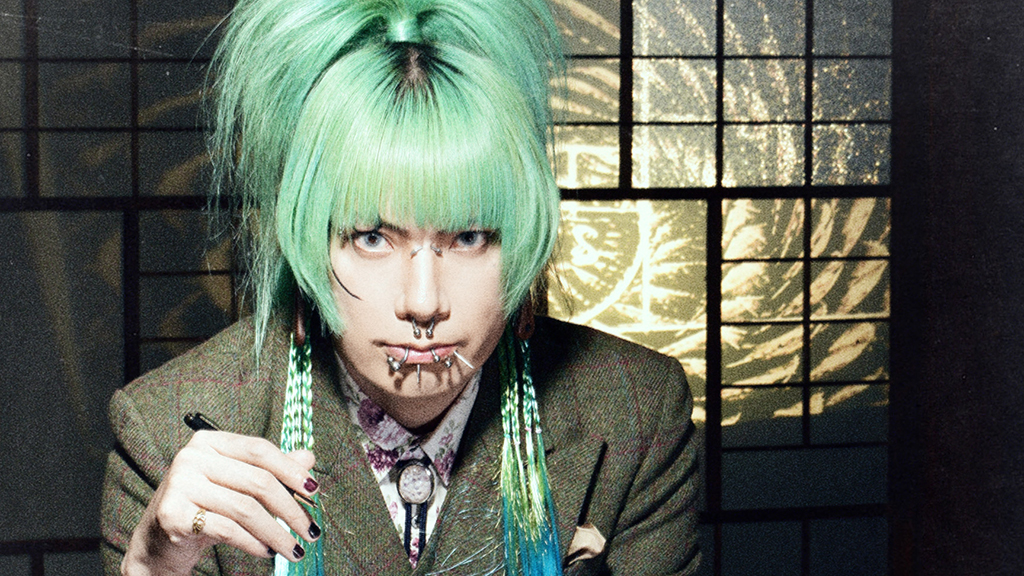
Psycho le Cému's seek Talks About His Solo Project as Sacred Ground and the Gap: "An Album Where People Can Definitely Hear Into My Deepest World"
This interview was originally published in Japanese on barks.jp. Translated by VK Chronicle.
Interview with Psycho le Cému’s seek
Psycho le Cému’s seek (B / MIMIZUQ, etc.) is releasing his first solo album, 白日をたゆたう雨虎、水に溶ける数列, on October 7th. Even if you’ve heard his shouting vocals on Psycho le Cému’s stage, the independent style of fingerstyle singing with acoustic guitar and upright bass reveals a subdued, husky voice that surprises all the more strongly if you have a strong impression of Psycho le Cému.
Based on folk songs, which are his own musical roots, the album features 11 tracks with minimal yet rich band arrangements, adding piano from Nishiyama Kosaame, guitar from aie (deadman, kein, gibkiy gibkiy gibkiy, the god and death stars), and drums from Teru Akagi (lynch.).
The lyrical world, which shows the influence of beloved literary figures, appears fantastical at first glance. Yet upon listening, it’s imprinted with raw honesty, the reality of being a bandman, and a yearning to preserve what’s fading. We present an extensive long interview exceeding 17,000 characters where seek discusses the depths of his solo project.
“I’ve loved various literary figures since childhood. Their influence is abundantly present”
Q: Congratulations on your first solo album, 白日をたゆたう雨虎、水に溶ける数列. First, could you tell us what prompted you to start your solo project?
seek: I started doing fingerstyle singing alone during the COVID period when band activities weren’t possible. I think all bandmen experienced this, but during that time, everyone was creating in various forms and through different methods of expression. Among those, I had a desire to stand on stage. Since group activities were difficult socially during that period, I thought, “Well, why not try this solo thing I’ve always wanted to do someday?” So I went ahead and did it in the chaos, in the form of solo fingerstyle.
Q: Psycho le Cému has a kaleidoscopic image, but this seek solo work, 白日をたゆたう雨虎、水に溶ける数列, has a dimly-lit worldview and bluesy, melancholic songs—I feel quite a gap.
seek: After doing Visual Kei for 27 years, and especially since Psycho le Cému has a particularly avant-garde image within Visual Kei, my original musical roots include folk artists like Takada Wataru and Tomobe Masato. When I started doing fingerstyle, I initially did self-covers of songs from the bands I’d been in. But then I realized, “Actually, I’ve been making songs that match the vocalist’s voice.”
Q: Starting a solo project gave you an opportunity to step back and observe your songwriting in Psycho le Cému, didn’t it? Naturally, you were making songs to fit DAISHI’s key and vocal qualities.
seek: Because of key issues and my own vocal qualities, for the first year and a half or so, I thought, “This isn’t working the way I want it to.” But I didn’t want to quit halfway, so I kept doing live shows—I’d book the next month no matter what, even if I embarrassed myself. Through all that, I wondered, “How much is this actually wanted by the fans?” And since 2021, band activities started coming back little by little, so I didn’t know how far I could challenge myself. But what I found through continuing with my solo work was the feeling that “I want to make songs suited to my own voice and really compete.” From that point on, I started pulling out past demo songs that seemed like they’d work for my fingerstyle performances, and I kept making original solo songs, including new material.
Q: Your husky voice really matches the worldview of this album.
seek: Maybe because I drink regularly, my voice is a bit hoarse or gravelly (laughs). With Psycho le Cému, I do a lot of shouting-like choruses, so my throat is basically always in a wrecked state. When I first started my solo work, I wasn’t that raspy, but I thought, “This time, this slightly worn-out vocal quality might work better,” so I consciously pushed it in that direction. But if I completely wreck it, I literally can’t produce sound anymore, so figuring out that balance of how much to rough up my voice—I learned that was unexpectedly difficult once I started doing it.
Q: I see.
seek: Since it’s solo fingerstyle, I had to think about what happens to the performance if my voice gives out. With a band, if one person’s string breaks, we can use talk to bridge the gap, and members support each other when something goes wrong—I grew up in that environment. So I’m thinking about things like, “What do I do on days when my voice doesn’t come out?” and continuing with that in mind.
Q: In this album, 白日をたゆたう雨虎、水に溶ける数列, your upright bass fingerstyle playing is prominent, but the piano also has a major presence.
seek: I asked pianist Nishiyama Kosaame to work on this. When I was handling the opening theme for the anime 男子高校生の日常 with Mix Speaker’s,Inc., there was a band called 雨先案内人 that handled the ending theme for the same anime. She was that band’s pianist. I’ve known her since then, and I reached out to her with the idea of doing a session together at a live show.
Q: So that’s where the seek solo style started to take shape?
seek: I thought “my voice and piano matching might be interesting,” and I also thought, “I’ve been doing just one acoustic guitar for so long—I want to try turning this into a band sound. If I’m going to do that, piano is a must.” So we started with piano and acoustic guitar, and while consulting with Kosaame about “wanting to try band arrangements,” we got serious about recording for the album about two years ago. That’s the rough timeline.
Q: Even if it ultimately became a band sound, the songwriting process must be different between your solo work and Psycho le Cému. Did you gain something from that?
seek: With the band, there’s a deadline for song selection meetings—members each bring a chorus or so of a song without lyrics yet. Then we decide how to arrange that track, and that’s the first time I write lyrics for one chorus, the vocalist sings it, and then we do pre-production. Especially since the vocalist I work with sings about two-and-a-half to three notes higher than me, with the technology available at that time, I couldn’t actually sing it myself and make a demo. But when you’re doing fingerstyle yourself, you can arrange it in your most comfortable key, and sometimes the lyrics and melody come together simultaneously. The feeling of—”I want these lyrics. I want the hook to be this word, with this setup first”—fitting perfectly into the melody is really satisfying. That’s become my songwriting approach since starting my solo work. Conversely, because I could be more conscious of how lyrics fit, I think I can now feed that back into the band.
Q: Changes in your songwriting are being returned to the band.
seek: With the band, we’ve been bound by internal rules like “this word in this chorus absolutely has to be in the title,” but with solo work, I can do whatever I want. The songs toward the end of the album are definitely deeper into my worldview in a way we’ve never done with my previous bands, and I think fans will really hear that. I feel like I was able to make an album like that this time.
Q: Throughout all 11 songs on the album, onomatopoeia is scattered abundantly. Track 8, “相食む,” has the line “Let’s make onomatopoeia.” There’s also “合言葉は『カンパネルラ』” in track 7, “夜掴奇譚”—it seems like a hint. I sense a worldview that connects to Kenji Miyazawa. Is this intentional, or did it happen naturally?
seek: I love Kenji Miyazawa, and since childhood I’ve loved various authors like Chuya Nakahara and Kobo Abe. Among bandmen-types, I grew up loving Kenji Otsuki, Yasushi Machida, and even Ramo Nakajima—he’s not exactly a band-type artist but did perform music—so I think their influence is abundantly woven through this. “夜掴奇譚” was inspired by the work 夜が掴む by manga artist Yoshiharu Tsuge, who recently passed away.
Q: So there’s a necessary logic to this artistic photo, which has the bearing of a literary figure. The influences you’ve received from creative works have become your blood and bone, and they’ve resulted in this album.
seek: I’ve always loved that retro worldview. Along with Yosuke Komatssu, who usually takes my artist photos, designer Satoru Misaki also came to this shoot. They both know well what I love. Especially Komatssu is like a textbook for me. A lot of the writers, films, and manga I like aren’t from the current era, and I vaguely love that world but can’t put it into words. Plus, I’ve rarely talked about these things with bandmates or friends from student days. Psycho le Cému is a band that talks about RPG worlds, monsters, characters—things like that—so the public image people have of us doesn’t align with my actual interests at all (laughs). So when I was younger, I wasn’t good at talking about these things. I kind of separated my interests from my band activities—”what I like is what I like, and the band is the band.”
Q: With your solo work, you could let what you love out in full.
seek: When I met Komatssu and talked about the things I love, he said, “Well, I think you’d like this too,” and lent me a DVD of an experimental film based on Kobo Abe’s work, directed by Hiroshi Teshigahara. He taught me all sorts of things. This time too, when I said “I’m thinking of taking artist photos like this,” Misaki found us a studio, and Komatssu and I went location scouting. Including the visual artwork, I think I was able to pack in what I truly love.
Q: The word “数列” (numerical sequence) in the album title also seems to connect to Kobo Abe’s sci-fi worldview.
seek: Actually, there isn’t that deep a meaning to it (laughs). My real last name is Hakumizu, so I wanted to hide my surname in the title. I included “白” (white) and “水” (water). I’ve had a lot of rain-related imagery before, and I just love rain, water—things like that.
Q: Has that been the case for a long time?
seek: Yes. Also, I really love fish. It’s hard to explain though (laughs). In high school, I worked at a Japanese restaurant, and when making sea bream head stew, I spent all day cracking open sea bream heads. That’s when I realized, “Oh, each fish’s face is different,” and I started being drawn to fish in a weird way. It’s not like I fish or keep tropical fish, but I use fish motifs a lot. A few years ago, I suddenly became interested in Fibonacci sequences and looked into them. That’s when I thought “sequences are interesting.” The mic stand objet I use now is shaped after the Fibonacci sequence too. This album is really just all of the things I genuinely love crammed together.
Q: The album ends with the words “魚になろう” (Let’s become fish) in track 11, “行雲流水,” and at the start of the instrumental opening track “dot,” you hear water sounds, creating a looping feeling.
seek: I think so. “dot” also means bubbles, so it’s all about being underwater. I’d been using an instrumental track as a house song for live show openings for a long time, and this time I rearranged it for the album version and changed the tempo. The drums from “夜掴奇譚” are used in this track too, so Teru Akagi’s (lynch.) drums appear right there. In terms of when it was made, “行雲流水” is the oldest. We host an event called <魚群> at LOFT PLUS ONE where bandmate friends and I do acoustic live talk sessions. I made this original song for that event. I learned the phrase itself from an essay by Kenji Otsuki called のほほん雑記帳, where he wrote that it was his personal motto. The phrase felt really comforting to me, and I wanted to make a song like that too. When we did a solo fingerstyle two-man show called <相食む> with Otsuki-san last year, I talked about that episode while performing.