
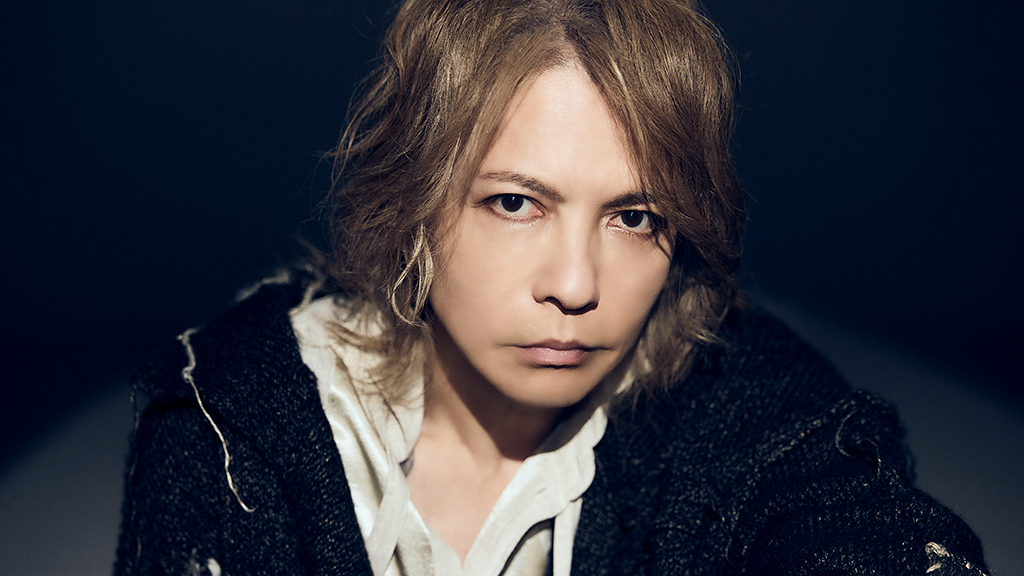
HYDE on 'JEKYLL' and Its Multiple Personalities: "It's Quite Crazy" — Exploring the Essence of an Artist
This interview was originally published in Japanese on barks.jp. Translated by VK Chronicle.
HYDE Interview: The Dual Nature of 『JEKYLL』
Approximately a year and a half after 『HYDE [INSIDE]』, HYDE released the album 『JEKYLL』 on CD on May 13th. If the previous work—which leaned heavily into metalcore—represented “movement,” then this new work is the complete opposite, unified by “stillness.” In terms of lineage, it’s positioned as a sequel to his first solo album 『ROENTGEN』 from 25 years ago, and as HYDE himself mentions in this interview, there are mechanisms that connect the two works.
That said, terms like “back to basics” or “nostalgia” don’t quite fit. This is a masterpiece where the dark, heavy worldview, its clarity and depth, the meticulousness of vocal expression—everything has spiraled upward to new heights. While taking the form of fiction, certain songs contain confessions of hidden inner feelings, allowing listeners to immerse themselves completely in HYDE’s bottomless appeal.
At the orchestra tour <HYDE Orchestra Tour 2026 JEKYLL> which opened on January 17th, the album’s tracks were performed before its release. Following the distribution release on March 11th, the CD release became highly anticipated. The tour concluded its domestic final on April 1st, with only additional performances remaining: May 17th in Wakayama and May 25th in Vienna, Austria. HYDE is the first Japanese rock artist to perform with a Vienna orchestra. This historic moment can also be experienced via livestream.
Much like figure skating, which coincidentally came up as an example in this interview, HYDE’s performances are born from the unity of technical training, the concentration and expressiveness of instantaneously diving deeply into a song’s world, and the three-in-one creation that results. We approached the worldview of 『JEKYLL』 by moving between the perspectives of live expression and album recordings.
◆ ◆ ◆
Finding Life in Reflection
Q: I reported on the domestic semi-final of <HYDE Orchestra Tour 2026 JEKYLL> (March 31st @ Pia Arena MM), and I was surprised at how much your vocal performance had been refined even further from the opening show in Fukushima Koriyama. At the domestic final on April 1st, you mentioned it was “a tour where I could face my singing.” What was your mindset going into each concert performance?
HYDE: I check video of each concert performance and make corrections to things like the lighting. When you do that, you inevitably start noticing things about your own vocals that bother you. That kind of brush-up, done every day, is what led to this.
Q: Was that something you hadn’t done in previous tours?
HYDE: No, I’ve done it before, but especially this time, since I was touring with the JEKYLL orchestra members, I thought—they wouldn’t want to play behind a poor vocal performance, you know? I didn’t want to embarrass them, and I felt I had to give them something as good as possible as an artist. The sense of responsibility was definitely different than before. I guess that’s just how much I’ve grown up (laughs). Especially at the final shows, I had the feeling I was able to sing really well.
Q: I heard the 『JEKYLL』 tracks live first, but experiencing them as an album format again, there were new discoveries. The song order, ending with “FADING OUT,” was shocking. It was such a striking finale, but what was your intention?
HYDE: That song just didn’t fit anywhere else. But the more I thought about it, the more I felt that song was the most 『ROENTGEN』-like. It has a fantastical quality, with an atmosphere that somewhat echoes “UNEXPECTED” (the opening track on 『ROENTGEN』). In that sense, I thought it would be nice to place it at the end so it flows back into 『ROENTGEN』.
Q: The contrast between the first half up to the fifth track “SO DREAMY” and the second half starting with “THE ABYSS” is quite vivid. I thought it fit perfectly as Side A and B of a vinyl record, was that something you were conscious of?
HYDE: No, not at all. Regarding the vinyl pressing, I just thought “I wonder if more tracks will fit?” Since there are only 10 songs, I thought there was plenty of room, so I tried adding another song, “LAST SONG,” but it didn’t fit. Now that I think about it, it’s exactly the length that would fit on a 46-minute cassette tape (about 23 minutes per side).
Q: It’s exactly the right length for listening all the way through. During the live show, “FADING OUT” was performed in the middle section where the scene changes, playing a role in shifting the worldview.
HYDE: The costume changes there too.
Q: From black HYDE to white HYDE. How did you conceive of that kind of presentation?
HYDE: I was imagining the Vienna performance in May. In Vienna, there’s a 20-minute intermission in the middle. With that in mind, I wanted to do something similar in Japan as well.
Q: I see. In composing “FADING OUT,” I understand you originally wanted to use the handpan?
HYDE: That’s right. I love that instrument and have always wanted to use it in a song someday.
Q: It’s not a particularly well-known instrument in general—how did you discover it?
HYDE: Where did I…?
Q: You’ve heard songs using it?
HYDE: Well, I’ve heard songs, and when you go to places like Kyoto, you see street performers playing it. When I was making songs for this album, I suddenly remembered—”Oh! I had that idea!” So hico played the handpan sound from his keyboard, and while he performed sort of improvisationally, I created the melody.
Q: The sound has a futuristic quality yet feels oddly nostalgic, creating a strange mood. It feels like a device transitioning from the mundane world to the sacred.
HYDE: I didn’t intentionally have that in mind, but in terms of separating it from the jazzy songs, I did want to pull it off completely there. We basically did all the jazzy songs in the first half of the live show, the costume changes there, and then we shift into a fantastical atmosphere from that point on.
Q: While 『HYDE [INSIDE]』 is “movement,” 『JEKYLL』 is conversely “stillness” as a category, but it’s an album packed with songs expressing various emotions. Were there any essential conditions or criteria in selecting which songs to include?
HYDE: The criteria is… how do I put it? It’s purely intuitive. Songs that I think “would work with an orchestra” or “couldn’t fit on 『HYDE [INSIDE]』 and couldn’t be done with L’Arc-en-Ciel either,” those kinds of songs.
Q: But L’Arc-en-Ciel has such diverse material. When you say “couldn’t be done,” what do you mean?
HYDE: Well, we could do anything, really (laughs). But L’Arc-en-Ciel can do anything, yet when you think about an album, we couldn’t unify it as a single cohesive work with just that. We could do one individual song, but an album like this would be difficult.
Q: You’re saying that as a concept, you couldn’t unify the entire work with that tone?
HYDE: That’s originally why I made 『ROENTGEN』 in the first place—I wanted to create something unified. Certainly, a single song might be something L’Arc-en-Ciel could do. But for example, even with a quiet song like “TATTOO,” if it’s a band, you have to include drums. Once that’s the case, you have to think in a different direction. That’s part of being a band too.
Q: Certainly, each member has various visions…
HYDE: Right. Because L’Arc-en-Ciel is a rock band, there are things we don’t want to do or can’t do, right? When that happens, there are quite a few songs on 『JEKYLL』 that just wouldn’t work.
Q: “TATTOO” was personally the most memorable song on this album for me. The orchestral arrangement without rhythm instruments is a major appeal. When and how was that song created?
HYDE: It’s one of the songs that came about while I was making songs for 『JEKYLL』.
Q: Is that recent?
HYDE: It might be the very last song I created. A heavy, dark song came about, and while making it with hico, I was like “this should be thoroughly dark and that’s good.” The melody came first, so he played piano in response to it, and I felt “this doesn’t even need rhythm.” At first I thought “maybe it should just be orchestra without even piano,” but in the end, having the piano worked better, so that’s what we did. The whistling in the interlude wasn’t originally there either. I suggested it by actually whistling—”what if a melody like this came in?” At that moment, the keyboard player happened to be away, so I just whistled it. And it worked surprisingly well, so we were like “okay, let’s go with the whistle.”
Q: The whistle has become an essential, crucial piece of “TATTOO,” hasn’t it?
HYDE: It really has. It oddly brings out the worldview, and yes, it works. I even wrote the lyrics afterward based on that. “If there’s a whistle here, this kind of story would be good.” My original concept was close to that too—I wanted it to be like a suicide note. But then I thought it was a bit strange to have a whistle at the end of a suicide note, so I decided “all kinds of things happened in this city, but I’m living here. ♪Whee whee whee (whistle)”—that kind of flow felt cleaner. Like someone walking through the city whistling, “I just drifted along with things and ended up living here”—that kind of narrative felt right. There are quite a lot of people like that, aren’t there? Me too.
Q: You performed this song seated during the live show. It felt like listening to a confession, a life’s memoir set to song, and reading the Japanese lyrics made me gasp. Rather than a fictional story, it felt like you were projecting yourself into it. How is that?
HYDE: Yeah, that’s exactly it. I’ve written down things I’m actually thinking.
Q: It’s a bit unusual to be this candid, isn’t it?
HYDE: The content is maybe a little heavy.
Q: That heaviness is actually comforting, but it does put the listener in a solemn frame of mind where you feel you must really take it all in.
HYDE: I’m at an age where… I’ve lived through all kinds of things in life (laughs). There are people I still resent, and conversely, I’m sure there are people I’ve caused sadness to. I think back on all of it. But there were beautiful things too, and taking it all together, that’s life, you know?
Q: It’s amazing how you expressed all that through the word and concept of “TATTOO.”
HYDE: It was originally a different word… I don’t remember what it was. But that didn’t fit well with the lyrics and melody, so I wanted something more title-like. Eventually the word “TATTOO” came to me and I thought “oh, this fits.”
Q: Rather than wanting to forget or erase pain, it’s about inscribing and keeping it. I imagined that’s the feeling you have toward all the events of your life.
HYDE: That might not have been my intention. It’s more like “it won’t go away anyway”—it’s resignation, really. That’s the feeling I had when writing it.