
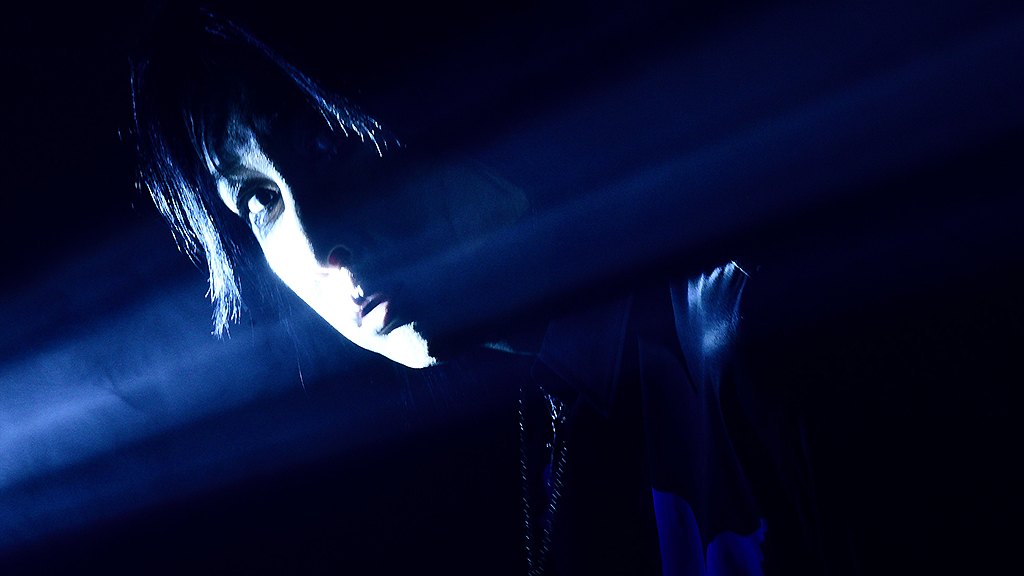
KIRITO on SHIFT: Beyond the Collapse of Fixed Ideas and Dramatic Change "Whether You Open the Door or Not, the World Changes by Your Own Hand"
This interview was originally published in Japanese on barks.jp. Translated by VK Chronicle.
KIRITO Interview: “SHIFT” and the Collapse of Fixed Ideas
KIRITO released his 1st mini album “SHIFT” on April 22nd. Following PIERROT’s reunion in 2024 and Angelo’s restart in 2025, his latest solo work releasing in 2026 marks an impressive new phase for KIRITO.
KIRITO’s solo albums “NEOSPIRAL” (November 2022), “ALPHA” (November 2023), and “CROSS” (November 2024) have successively presented his evolution as an artist by fusing refined philosophical thought with aggressive sound. And now “SHIFT” is released—symbolizing a “paradigm shift”—with the collapse of preconceptions and the revolutionary transformation of values condensed into lyrics and sound, creating something supple and beautiful.
“Including lyrics and sound, this time the story I’ve woven together felt like a dramatic turning point to move forward—that meaning weighed heavily on me,” he says about “SHIFT.” Why has KIRITO’s original melodic sensibility been elevated in this work? Where is the series of narratives he’s continued to draw across the worlds of PIERROT→Angelo→KIRITO solo heading? We present a long interview where KIRITO’s aesthetic and resolve are etched into “SHIFT”—a work revealing destruction and creation toward the future, and evolution that knows no pause.
“Religion and Quantum Mechanics Exist Simultaneously—Because I’m Conscious of Their Interrelationship, I Use the Term ‘World Lines’”
Q: “SHIFT” was created following PIERROT’s reunion in 2024 and Angelo’s restart in October 2025. What were you thinking about before creating it?
KIRITO: As a fundamental premise, I connect stories through the music I create. In other words, everything—PIERROT, Angelo, KIRITO solo—I describe each as “different world lines,” and I’m working on how to connect them, how to run them in parallel. Over these past few years, including that kind of work, I’ve had the sense of constructing an epic story.
Q: Even though they’re separate projects, there’s a consistent sense of narrative running through them.
KIRITO: Having gone through those years, the album “SHIFT” became a work with strong meanings of “paradigm shift” and “shift change.”
Q: The collapse of fixed ideas, the shift to new normals—revolutionary or dramatic changes in perceptions and ideologies that were once taken for granted, and values across society. That applies to the sound as well, right?
KIRITO: The previous three solo albums were works that pioneered heavier territory. Before that, while I was good at melodic things, I might have been seen as struggling with vocal styles that pushed through with shouts and power throughout entire songs. But through solo work after Angelo’s hiatus, I made three albums prioritizing power in a way that overturned how I was perceived, and I was able to refine my own style. So this time, I felt like returning to my roots. As a result, the album “SHIFT” has the sense of being a work where the focus changed to showcasing melody.
Q: All six included tracks share a melodic quality while featuring songs with different tastes—it’s an impression that every song has high quality.
KIRITO: In songwriting too, the previous three works had parts where I deliberately sealed away what I’m good at. But this time, I had the desire for people to understand where I, KIRITO as a musician, am heading. It’s not about individual songs—I wanted to express through the whole album and my stance that “KIRITO is going this direction.” Simultaneously, I had a strong desire to show the high quality of each song and the breadth of my repertoire, so I think it became that kind of album.
Q: Do you imagine the overall picture of the album first and then compose songs according to that vision?
KIRITO: I approach albums with a sense of storytelling from the first song to the last, so I create songs carefully with the story’s plot in my head. Of course, specifically deciding what kind of song each track will be comes later, but I do think through the overall framework first—like, the first song should be this way, and toward the end I’ll create this kind of emotional gradient in the sound.
Q: You mentioned the word “story,” and tracks like “PARADIGM SHIFT,” with its dark verses and opening choruses, or “SIGNAL” with its multilayered developments, all demonstrate narrative qualities within “SHIFT.”
KIRITO: Previously, in order to clearly convey what the overall album should be, I focused more on consistency with the album’s direction rather than variety. But this time with “SHIFT,” it’s different—I wanted to show six completely different scenes across the six songs. To show as much breadth as possible, I really thought through the flow within each individual song.
Q: “蒼く浮かぶ月” (The Moon Rising Blue) is a ballad too—you’d expect the chorus after the A-section and B-section, but instead it’s a C-section. Then it deepens further in what amounts to a D-section chorus. The flow is exquisite.
KIRITO: Having composed various songs over time, I’ve naturally developed styles about “how song structures should be,” but rather than being bound by theory, it’s about considering the world of the lyrics and emotions. For example, is the melody before the chorus really less important than the chorus? Not necessarily. There’s a place called a B-section that isn’t a B-section, something that’s like a chorus but also isn’t—every section’s melody can be the lead role.
Q: So everything’s like a chorus.
KIRITO: It’s not that exposed inner emotion automatically makes a high-quality chorus. Put another way, it’s not a matter of going from B-section to chorus. Beyond what would typically be a chorus, there’s something extracted from emotion—something unknowable—that might be the chorus that exists in this song. That’s how I understand it. I’m ignoring the definitions of typical rock and pop song structures to some extent.
Q: Yet the song structure doesn’t fall apart, and it lands with conviction. It evokes story while maintaining a wonderful sense of balance between sound and lyrics, with impressive information density.
KIRITO: Including lyrics and sound, this time the story I’ve woven together felt like a dramatic “turning point” to move forward—that meaning was significant to me. That’s what “SHIFT” means. It’s definitely not just “the musician KIRITO hit a turning point and went this direction.” KIRITO as an artist is merely a narrator and a composer creating sound. The story moves separately, so in a way the story itself feels like a living thing.
Q: Having encountered this major paradigm shift, where is the story heading?
KIRITO: I’m a narrator and a creator, so I might understand certain parts, but the story advances organically, progressively, or autonomously, so I can’t predict what developments will occur. Within that, “SHIFT” is a work that announces “this is the paradigm shift.” In the lyrics’ world too, I wanted to depict that turning point of “we’ve encountered a paradigm shift.” Once that happens, the appearance of the songs changes dramatically compared to before, and I think that connects to the kind of “balance” you mentioned. That said, it’s not like “SHIFT” marks the beginning of KIRITO becoming a complete, polished vocal work, and it might go somewhere completely unexpected. At this stage I won’t say, and I think that’s fine.
Q: Regardless of direction, you consistently produce high-quality songs. So, moving to lyrics—I felt the theme “repeat = eternity” covers this work entirely.
KIRITO: As I mentioned at the start, as a premise there’s a large continuous flow existing as the story. So you could interpret repeat as rebirth or eternity, but this time it’s not in a religious sense. Previously, the lyrics had a sense of cyclical reincarnation—once something ends, another story begins—but within me, something religious coexists simultaneously with something scientific and quantum mechanical that seems contradictory at first glance. Because I’m very conscious of their interrelationship, I use the term “world lines.”
Q: Parallel worlds of religion and science, with branching points.
KIRITO: If repeating life and death is reincarnation, then creating by branching world lines is “marking time” in quantum mechanical terms. Living through each second—through countless choices and observations—creates new worlds and selects branches. In other words, the vast infinite repetition of creating and ending world lines quantum mechanically is, when interpreted as “living itself,” also repetition of ending and beginning—in other words, repeat. So whether you open the door or not, the world changes depending on you.