
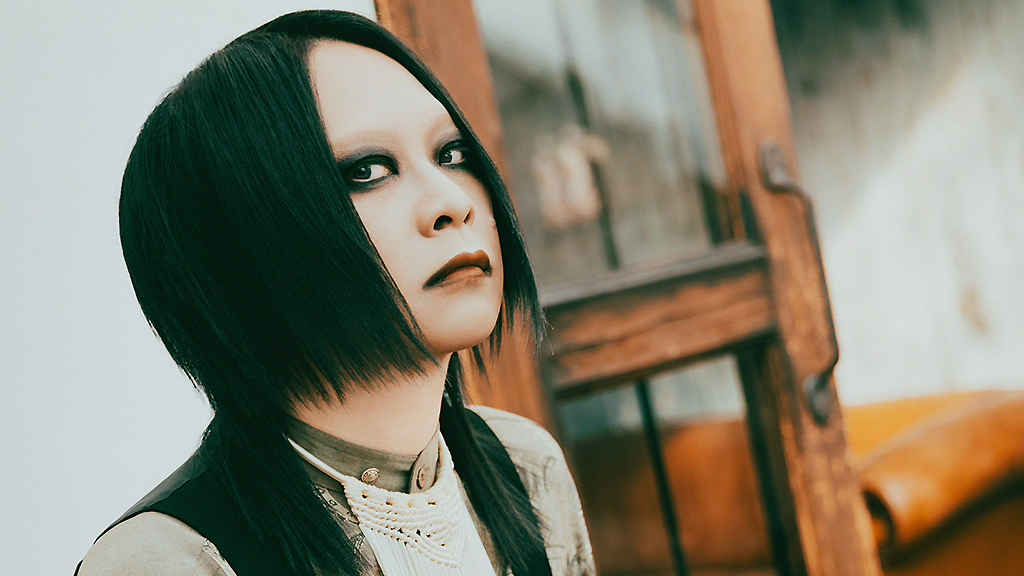
Tatsurou (MUCC) on His First Solo Single of 2026 "checkmate": A Real Sense of Presence — "It's My Coordinates, Standing Here Right Now"
This interview was originally published in Japanese on barks.jp. Translated by VK Chronicle.
Interview: Tatsuro (MUCC) — Solo Single “checkmate” Carries a Realistic Atmosphere: “It’s Like Coordinates Showing Where I Stand Right Now”
Tatsuro from MUCC has completed his first solo single of 2026, “checkmate,” which will be released on March 11th. A sharp departure from his previous single “VILLAINS”—which depicted a dark hero world centered on the theme of “villains”—”checkmate” is a track layered with energetic lyrics over powerful rock sound.
Behind this latest work, which Tatsuro describes as being born from “conceptual expression that isn’t conceptual, but rather realistic expression,” lies something deeper. Four years since his solo debut, Tatsuro has steadily built momentum through multifaceted approaches including acoustic live performances. His solo world is entering yet another new season. His words in this interview—”It feels like something’s about to be completed”—have made the upcoming <LIVE HOUSE TOUR [VILLAINS chapter 2]> all the more exciting.
Additionally, we’ve got a lengthy interview packed with topics: behind-the-scenes stories from the Visual Kei vocal gathering that Tatsuro hosted and became a hot topic on social media, the talk live with allies <Second Annual Showa Remnants New Year’s Party ~Hilarious Talk and Occasionally V’s Masterpieces>, MUCC’s 30th anniversary coming in 2027, and much more.
“checkmate” distribution
◆ ◆ ◆
A Song That Becomes a Breakthrough Moment When You’re Wavering Over “What Should I Do?”
Q: You released the single “VILLAINS” in September 2025, held the live house tour <LIVE HOUSE TOUR [VILLAINS]>, and announced at the final show that you’d be holding <LIVE HOUSE TOUR [VILLAINS chapter 2]> starting March 2026. Did the response from the tour featuring “VILLAINS” turn out to be quite significant?
Tatsuro: Yeah. The September tour went really smoothly. I didn’t really have any vision for the next work initially, but I thought I wanted to continue that atmosphere a bit longer, so I decided on the title <chapter 2>.
Q: You’ve mentioned before that “VILLAINS” itself was a song designed to be performed first and establish the world view—did that work out well?
Tatsuro: It’s more about the overall atmosphere of the entire tour, rather than just that song’s world view. The tour ended on this note of “It feels like something’s about to be completed. Things feel like they’re going to get even better.” So I thought I wanted to add past songs we haven’t included yet and new songs with a similar feel to brush everything up.
Q: From the tours for albums like ‘COLORS’ and ‘MONOCHROME,’ were there things you consciously changed?
Tatsuro: It wasn’t so much something I consciously did—it was more like I naturally stumbled onto something. With ‘COLORS’ and ‘MONOCHROME’ tours, we had to perform a lot of the album tracks, but since “VILLAINS” was a single, we could pull out past songs again and mix them in. That was my first time doing a setlist that way, and good flow was happening, so I thought maybe next time we could add even more variation.
<Tatsuro ACOUSTIC LIVE TOUR [sing for you]>
Q: So “checkmate” is the new song you created with the next chapter in mind?
Tatsuro: Yeah. A song that could work as a grabber at the beginning of a live show, or that could be used to build momentum in the second half. That’s what I wanted to create. At first, I was imagining something with a more mature band feel—something stylish—but as I progressed with arrangements, I thought the current direction works too, and it turned out to be a cool song.
Q: Is there an aspect where it continues the world of “VILLAINS”?
Tatsuro: Nah, I didn’t really think about that. I did consider whether I should tie them together, but I decided to write it freely without thinking about it. There are patterns where setting constraints makes things better, and patterns where restraints make things worse. With this song, I felt forcing a connection wouldn’t work, so I created it freely without overthinking. I just wrote what the song inspired in me, what I felt naturally. When you write hot lyrics for rock-style songs like this, they can end up sounding like anime songs. I didn’t want that kind of intense, hot energy in the words, but I did want catchiness. The melody in the chorus has a lot of notes, so it’s not something you’d remember just from one listen—so I challenged myself to make it sound catchy through how the words are placed. It turned out well, so I’m satisfied.
Q: So you were building it up from the chorus word?
Tatsuro: No, I absolutely write lyrics in order from the beginning. If you write from the chorus first, the work of making everything connect before and after becomes a real pain. Thematically, “checkmate” has strong spirituality, but I thought it shouldn’t be too inward-focused, shouldn’t get too serious. So I made it catchier, more imagistic—that’s the idea.
<Tatsuro ACOUSTIC LIVE TOUR [sing for you]>
Q: You mention it’s “spiritually strong”—what was the theme?
Tatsuro: There are things you have to decide as you live, things you have to settle on in your own way, right? I experience those kinds of moments a lot in my own life, and I thought “If I have them, anyone would.” It doesn’t matter if they’re small things in daily life—the image was of a song that applies when you’re wavering over “What should I do?” I think the lyrics ended up fitting those moments. I hope the lyrics I freely wrote might catch on someone somewhere and become the song that helps them break through something.
Q: It’s not just venting negativity, and it’s not just pushing someone forward positively—it has a particular temperature to it.
Tatsuro: Japanese people tend to have this odd sense of responsibility, you know? You have to maintain relationships with people around you, so a lot of people end up living bound by “I have to meet expectations” or held captive by others’ evaluations. Since few people can live thinking “I’m me, what others do is their problem,” I wanted to write a song that lets people think “That’s enough of that” and take a step forward. It’s that kind of driving song. To achieve that, I made sure the chorus wasn’t complex-sounding, used words that hit your ear immediately, made it a refrain.
Q: The phrase “I want to blame it all on someone else” is catchy and memorable in its own way.
Tatsuro: My own thinking is that I can’t really blame others. Even if I end up in that kind of situation, I think “I chose this, right? Ultimately it’s my fault.” So I think “If only I could blame it all on someone else” (laughs).
Q: Because you can’t actually do that, the words come through.
Tatsuro: Right. Because the song has that driving energy, I can express that part comically in a way. Some people might find it heavy, but I didn’t want to make it such a deeply serious song. People in heavy situations tend to sink deeper into their thinking, so I wanted to make a song that’s almost like saying “Do you really need to feel that much pressure?” I think I managed that.
<Tatsuro ACOUSTIC LIVE TOUR [sing for you]>
Q: As a result, it’s fun to listen to, and it’ll be a song people can smile along with at live shows. Is “What kind of feeling do I want people to have when they hear this?” an important part of your lyric-writing process?
Tatsuro: More like—I used to think everything I was carrying inside was all there was to the world, but I realized that’s not the case, and that it doesn’t have to be. So to the extent that I now think “It’s okay to brush things off in a good way,” I’ve found I don’t want to get too serious about each individual theme lately.
Q: I see.
Tatsuro: I’ve experienced a lot with age, and I don’t despair over trivial things anymore, but when I was young, that wasn’t the case. You don’t know anything, you don’t have experience, so you get emotionally up and down over small things, despair, feel sad. But that’s not how it is now, so even if I sing that kind of song, it doesn’t feel real to me. If it’s not real, the feeling doesn’t come through in the song, and I want to sing from my actual size, with realistic atmosphere.
Q: So it’s not that your personality became more optimistic, but your way of expressing and receiving things changed.
Tatsuro: Yeah. When I was a kid, there were adults who’d comfort me saying “That’s not a big deal, you’ll be fine,” and I’d think “What? You don’t understand at all!” But now I’m at an age where I can understand that “The adult’s feelings were real too in their own way.” So if I reach that age, I should sing those kinds of songs. If I stand in the same place from the past all this time, that’s what becomes unrealistic. I think I should sing the values of whatever era I’m in. It’s like coordinates showing where I stand right now.