
BabyKingdom on New Attraction "ハピネのかくれんぼ" Release: "We'll Deliver a Space Filled with Magic to Everyone"
This interview was originally published in Japanese on barks.jp. Translated by VK Chronicle.
BabyKingdom Interview: The Happiness Hidden in the Forest
BabyKingdom, who will celebrate their 10th anniversary in 2026, released a new attraction “Hapine no Kakurenbo” on March 4th.
This work was created with the theme of “discovering happiness hidden in everyday life—happiness—with your own eyes.” Using band sound and Celtic music-like soundscapes, they’ve crafted an uplifting single that expresses a fairy tale world where magic and fairies dwell. The members spoke at length about this release, which also carries gratitude for their approaching 10th anniversary.
Q: This time, BabyKingdom is presenting a new attraction—the single “Hapine no Kakurenbo”—which depicts a “Forest Fantasia” world centered on Hapine, a forest fairy, as the protagonist. Could you first explain the circumstances that led you to step into this new musical and narrative territory?
Shiki (G): Let me briefly recap what’s led to this point. We had a turning point with the album FUNNY∞CIRCUS released in spring 2024. After that came the single “CALAVERAS/Salsaruosa” themed around Mexico’s Day of the Dead, then “SEIMEI” depicting an Onmyoji, and “ALPHA Kuyō/Hirakegoma” inspired by One Thousand and One Nights and Arabian music. Looking back, our recent singles have largely been in minor tunings.
Q: You’re right—there were definitely a lot of cool songs that made good use of those minor key sounds.
Shiki: I think minor tuning does make it easier to bring out a certain coolness within the Visual Kei framework. But from my personal perspective, one of BabyKingdom’s biggest strengths is actually our ability to pull off major-key songs in a way that’s distinctly us. So my first instinct for this single was that I really wanted to do something in a major key. That said, creating a major key song is incredibly difficult.
Q: In what way is it difficult?
Shiki: When I compose in a major key, it often ends up sounding like accessible J-pop. Which is fine in itself, but I’ve always felt it was “not quite right” for a BabyKingdom single A-side. So I found myself wondering: “What would a major key song that’s right for a BabyKingdom A-side actually be?” I’ve been exploring that question with each release since FUNNY∞CIRCUS. This time, I approached it differently—rather than starting with the chord progression, I first came up with the image of a candy house as a motif, then built the song from there.
Q: So you were thinking of Hansel and Gretel from the Grimm fairy tales?
Shiki: Exactly. I created the demo for the title track “Hapine no Kakurenbo” with that image in mind. When I consulted with Sakugo midway through, he suggested, “What if we expand this into a bigger framework?” That’s how we moved toward the “Forest Fantasia” direction. Musically, we incorporated Celtic elements, which—for me—naturally connected back to the candy house theme.
Q: Could you explain that connection?
Shiki: Modern pop music basically traces its origins back to classical Western music. Celtic music, on the other hand, is rooted in the folk music created by ancient Celtic peoples, so its origins and history are quite unique. But the instruments used are actually quite similar.
Q: Celtic culture is still transmitted in places like Ireland, Scotland, Wales, and Brittany in France, and since the Celtic people originated in what’s now southern Germany and Austria, it makes sense that there would be connections to Western music.
Shiki: However, Celtic music has one major characteristic: it’s performed by small ensembles. The atmosphere is something we’ve tried to express in the MV as well—people gathering in small numbers in a forest or a cottage, all playing one main melody together, enjoying it together. That was apparently the classical style. It’s the complete opposite of the grand Western music you’d hear in orchestras; Celtic music developed as something intimate and small.
Q: The bloodline of folk music is certainly strong. When it later traveled to North America and evolved into country, bluegrass, and folk songs—all of which work as intimate music—that makes perfect sense.
Shiki: Even though classical music started with chamber music, it evolved by adding complex harmonies to a single melody, layering different melodies through counterpoint, and progressively expanding in scale. With the Celtic style of everyone enjoying one melody together, I thought we could incorporate that well into BabyKingdom’s sound.
Q: By the way, why did Sakugo want to expand beyond just the Hansel and Gretel imagery for “Hapine no Kakurenbo”?
Sakugo (Vo): The candy house from Hansel and Gretel is also in the forest, so the fundamental image Shiki came up with hasn’t changed. But when building a story from that, the world felt a bit too narrow for what I wanted to express. I thought if we broadened the world view, we could create a more interesting way to present it—not just in the song and lyrics, but also in our four members’ costumes and the MV. Also, since we’re releasing three songs at once this time, I really wanted to do Peter Pan as one of them.
Q: There’s a coupling track called “Neverland.”
Sakugo: Yes. It’s a theme I’d wanted to express musically for a while, but Peter Pan also felt like something that would be too narrow to fit into a single A-side (laughs). So, keeping in mind that both what Shiki wanted to do and what I wanted to do involve fantasy elements, we decided to deploy both attractions as one area—Forest Fantasia—in our MUSIC THEME PARK.
Q: In your previous single “ALPHA Kuyō/Hirakegoma,” you opened the Arabian Coast area, and your MUSIC THEME PARK continues to expand (laughs).
Sakugo: Depicting a story that takes place in a forest is genuinely our first time doing something like this. This time, I wanted the songs, costumes, and MV to all have a scent of the woods lingering through them. We’re trying lots of new things across different aspects.
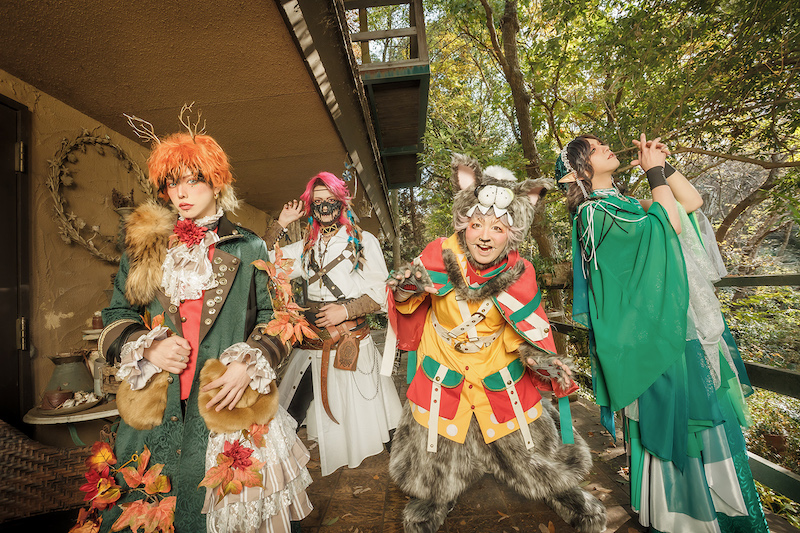
Q: Now, shall we do the traditional role announcements? Visually, you’re using red and green as your main colors—quite avant-garde styling again.
Sakugo: I’m a non-human creature with deer antlers. I was once a human nobleman, but as I settled in the forest, I became a fairy. I’m also a guide through the forest. Shiki is, as you can see, a hunter. Toramaru is a goddess protecting the forest spring—genderless, I suppose?
Toramaru (Dr): No, with this look, I’d say goddess (laughs).
Q: There’s definitely a vibe of you emerging from the spring’s depths if someone dropped an axe in it.
Toramaru: “Which axe is the one you dropped?” (laughs)
Q: And Moniyo’s appearance…?
Sakugo: Moniyo is “eaten by the wolf Moniyo.” They’re caught between the wolf’s upper and lower jaws (laughs).
Q: Impeccable casting as always (laughs). Earlier, at the end of last year’s tour final, Shiki said in an MC: “We BabyKingdom are approaching our 10th anniversary next year, and thinking about what we want to do in our 10th year, we realized we want to share the joy and happiness of continuing to perform and create joyful stages together with everyone. So next spring will be incredibly happy days!” It seems “Hapine no Kakurenbo” is a clear manifestation of that stance.
Shiki: That feeling was very strong.
Sakugo: The title “Hapine no Kakurenbo” itself comes from the word “happiness.” As we approach our 10th year, it’s important to find new happiness moving forward. But before that, there are band members, fans we call “babries,” staff supporting us—and the fact that we can continue this band at all. I wanted to make sure we first properly notice the happiness that’s at our feet and in our surroundings, and express gratitude for it. That’s why I wanted this to be the first release of our 10th anniversary year.
Q: Now, let’s delve deeper into the details of the title track “Hapine no Kakurenbo.” Since you mentioned it’s based on Celtic music, what did you prioritize when crafting the final form?
Sakugo: The B-section and the end of the chorus have a slight shuffle feel to the vocals, but what I was imagining was a band of musicians in the forest. As Shiki said, we also valued the major key aspect. I wanted it to be a song with a bright melody that everyone could hum along to happily together.
Q: What did you keep in mind when constructing the rhythm?
Shiki: This actually ties back to the 10th anniversary keyword. The marching-like rhythm that comes in early on is a self-homage to “TOY&MAGIC” from 2018. That was a technique we used when we made that song with the concept of toy soldiers. Also, that “zutta-zutta” rhythm in the intro is from “Ride On The Beach,” released in 2017. So this time, I intentionally combined things we’d done before, constructing the rhythm that way. I wanted to explore how we’d approach those past techniques now as BabyKingdom.
Q: When Toramaru faced this rhythm containing elements from the past, did you feel anything?
Toramaru: It was strange, honestly. I didn’t feel like I was playing old phrases at all. It felt like I was purely playing something newly and solidly constructed. It’s a self-homage, but not one that’s obvious. It’s the kind where you’d think, “Really, without you telling me, no one would know!” (laughs)
Q: Since this is a Celtic-nuanced song, you weren’t going for the typical rock drum aesthetic, right?
Toramaru: Exactly right. So I’m actually thinking about how to handle this in a live setting. I haven’t really done songs with this kind of atmosphere before, and normally I’d think about how to make everything heavier, but this time I felt like I absolutely couldn’t go metal. In a way, it was somewhat uncharted territory. And I really felt anew how difficult pop music is. All three tracks on this release share that challenge.
Q: For Moniyo’s part, how did you approach “Hapine no Kakurenbo” as a bassist?
Moniyo (B): I’m going to complain as usual, but this was difficult too (laughs). When the sheet music came from Shiki, he explained what we were going for, and since the drums were keeping a steady rhythm unlike usual, I got this mysterious request to “add variation with the bass” to create contrast. In the end, while it’s not in an obvious form, I personally felt I made quite a bit of progress as a bassist. It’s become a song where I can feel my own growth.
Q: Your bass lines sound very refined.
Moniyo: Over the past year or two, I’ve been focusing on the precision and refinement of my bass playing, so I think “Hapine no Kakurenbo” is where I expressed that as a kind of culmination. You see, I’m naturally good at minor-key walking bass. So the fact that I could bring out lightness and pop-style rhythm sense for this rare pop A-side song gives me a real sense of achievement. It’s great to be able to play to my strengths.
Q: For you, Shiki, what was your role as a guitarist on “Hapine no Kakurenbo”?
Shiki: I think this is something that comes from being in a position where composer and player are in tension with each other. What I focused on most was creating a Celtic atmosphere while as a player staying in the middle of contemporary music. To do that, I minimized the number of notes. The thing is, people don’t listen through speakers much anymore, right? Earbuds connected to a phone, tiny computer speakers—that’s probably how most people listen. In that environment, if you pan electric guitars left and right or pile three together in the center in a grand way, you risk breaking the overall balance. So this time, I was conscious of how far I could go with just one guitar.
Q: So restraint was necessary.
Shiki: Exactly. There’s fiddle, mandolin, and Irish flute in the intro, and if I’d layered a heavy guitar sound on top of that, it would’ve ruined everything. Not to disparage other approaches, but you know how some bands add full orchestration to their tracks? I think that’s actually very difficult. That’s because the electric guitar is fundamentally an orchestral instrument itself—it can cover first violin, second violin, viola, cello—so if you add actual orchestral instruments, you end up with everyone killing each other sonically. So I wanted to avoid that as much as possible, and instead distilled the guitar down to single phrases and poured my soul into those.
Sakugo: The second verse B-section even has Fa○ma doing hide-and-seek in there (laughs).
Shiki: Since it was such a forest and greenery-heavy song, I was wondering if there was something fun I could slip in, so I added the Fa○ma store entrance sound just for fun (laughs).
Q: Even those subtle tapping-style beautiful phrases come through, and those effects are born from having stripped down the sound, aren’t they?
Shiki: Normally, the chorus would be the moment you’d go bang and play the strongest sound, but I deliberately didn’t do that. In the chorus, the guitar doesn’t play chords—it approaches as a lead. The bass is in the center, guitar on the right, and in the empty space on the left I put first and second violas, and then stereo piano on top of all that. That creates the Celtic nuance without being too grand.
Q: It’s not austere or thin—it’s refined yet clear, with depth.
Shiki: For the detailed sound design, the engineer was incredibly skilled, so I incorporated their input as well. Honestly, we spent the most money on guitar recording this time (laughs). I think most artists record at home these days, but we booked an amazing studio just for guitar recording, and we used six microphones for it.
Q: That’s quite extravagant.
Shiki: The engineer even said, “This kind of thing doesn’t happen often!” (laughs) But to capture that minimal “people playing in a cottage” feeling that’s at the heart of Celtic music, I couldn’t just use the mic sitting in front of the amp. I wanted to perform with the actual spatial resonance.
Q: So you prioritized the ambient quality.
Shiki: That’s it—I set up four mics just for the ambience. I really wanted to capture the air vibration, the analog resonance.
Q: Speaking of guitar, it looks like you’re using quite a vintage-looking guitar in the MV. Did you use that guitar for the recording too?
Shiki: The one in the MV isn’t actually vintage. It’s a guitar I bought when I was twenty, and I love it so much that I’ve used it constantly. The color has faded a bit from heavy use, so it just looks vintage now (laughs). But for the recording, I used an even older one—the very first guitar I ever bought.
Q: Why did you use that older guitar for the recording?
Shiki: This is going to be pretty nerdy, but is that okay?
Q: Please, I’m interested.
Shiki: The guitar I normally use is a 24-fret long-scale model, but for recording I used a 22-fret medium-scale Fender Stratocaster. I use the 24-fret one normally because lots of BabyKingdom songs require it. But the core guitar sound for me is that 22-fret tone, so I tried to get the 24-fret as close as possible to it. But my guitar tech told me, “You can’t get the 22’s tone 100% from a 24-fret,” so since then I’d been playing the 22-fret only at home. But for “Hapine no Kakurenbo,” I really needed a “thin yet powerful sound,” so I used the 22-fret Fender Strat. Sorry for the overly detailed talk (laughs).
Q: Not at all. Very educational, thank you.
Shiki: The kind of focused, concentrated sound I was aiming for—that pinpointed frequency—was essential for this song. Figuring out how to coexist with my desired sound and what BabyKingdom wants to express is something I