
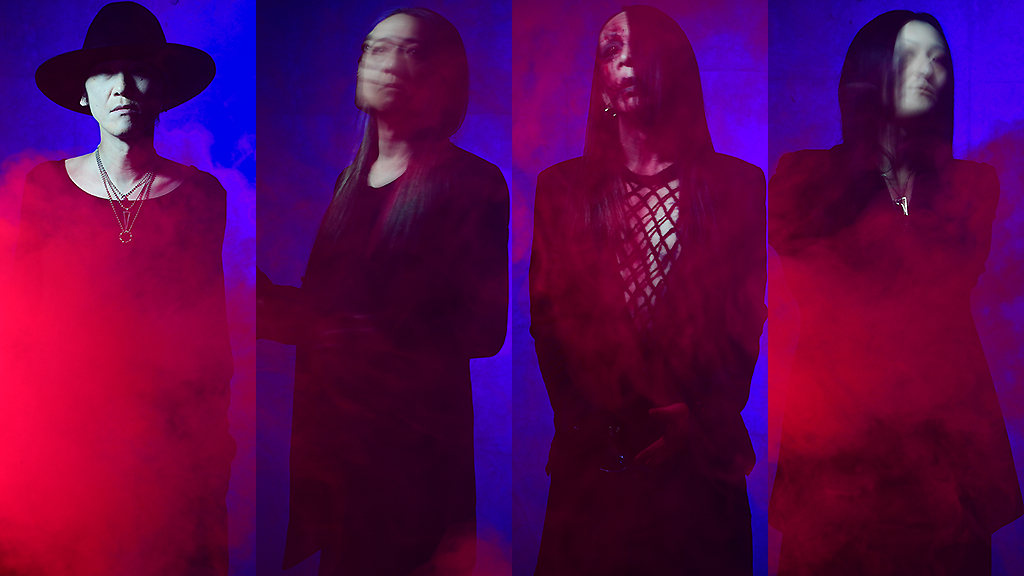
gibkiy gibkiy gibkiy on Their 10th Anniversary and Unconventional Musical Style: "We Want to Lean In Further and Break Through"
This interview was originally published in Japanese on barks.jp. Translated by VK Chronicle.
gibkiy gibkiy gibkiy Interview
gibkiy gibkiy gibkiy marks its 10th anniversary in 2026. The predecessor unit highfashionparalyze, formed by kazuma (Vo / ex-Merry Go Round, Smells) and aie (G / deadman, kein, the god and death stars, THE MADCAP LAUGHS), welcomed sakura (Drs / ZIGZO, Rayflower, THE MADCAP LAUGHS, ex-L’Arc-en-Ciel) in 2014 and began operations as highfashionparalyze+sakura. In 2015, kazu (B / the god and death stars, ex-蜉蝣) joined the group, forming the four-member HIGH FASHION PARALYZE. Then in 2016, the band took on its new name: gibkiy gibkiy gibkiy.
“In terms of wounds, it’s all bloody and sticky,” kazuma said in a BARKS interview at the time of their 1st album 『不条理種劇』 release (announced February 24, 2016)—words that captured his own musical identity. The style they created is too artistic to be called improvisational music, too avant-garde to be called a band sound. It is nothing but the result of the four members’ extensive experience and achievements, combined with their high level of skill and the intense spark of creative inspiration.
Exactly 10 years have passed since gibkiy gibkiy gibkiy’s first live performance on March 5, 2016, at Meguro Kanmeikan in Tokyo. On March 5, 2026, the four members will hold <gibkiy gibkiy gibkiy 10th ANNIVERSARY × clubasia 30th ANNIVERSARY “avantgarde,barbarian ‘唾液’”> at clubasia in Shibuya, Tokyo, and will embark on a Tokai-Kansai-Kinki regional tour starting with this performance. To commemorate their 10th anniversary, BARKS conducted an in-depth interview to explore the band’s unchanging essence and the current evolution of these four talented individuals.
2016 / gibkiy gibkiy gibkiy
◆ ◆ ◆
Subtraction and Just How Chaotic It Gets / Old Guys Getting Angry Are Scarier After All (laughs)
Q: gibkiy gibkiy gibkiy is marking its 10th anniversary in 2026. BARKS conducted an initial interview with you in March 2016 when you started out, and I feel like you’ve spent these past 10 years refining the “avant-garde sensibility that doesn’t pander to anyone” and the “highly improvisational music where people’s raw selves are exposed”—the qualities you talked about back then—without losing sight of them. How does it feel for the band to hear that a decade has passed?
sakura: While preparing for this interview, I re-read the articles from that first BARKS interview and all the other gibkiy gibkiy gibkiy coverage over the years, and I also made archives of our live performances. What struck me was that while we’re doing it, you don’t really feel like 10 years have passed. But when you take time to look back like this, it really does sink in that a whole decade has gone by.
kazuma: I don’t really feel the weight of 10 years either. But I do think I’ve changed quite a bit during that time personally. This is just my own sense, but now I have a clear picture of what we should be doing. When it comes to the sound, I can now clearly see what would sound cool with these four of us.
Q: Is that influenced a lot by the accumulated effect of performing so many shows? Over these 10 years, especially in recent years after the pandemic, the band has been consistently touring.
aie: With that, kazu comes up with our yearly activity plans. Before that, we were doing one-mans pretty freely and only took offered festival gigs. But for the past five or six years, the standard has become “let’s do two or three one-man tours per year.”
Q: Each member has other bands and projects going on simultaneously. As kazu, do you have a particular philosophy in how you keep gibkiy gibkiy gibkiy running?
kazu: In the first few years, I was really pushing to do releases and live shows consistently. We put out two albums—1st album 『不条理種劇』 (released February 2016) and 2nd album 『In incontinence』 (released August 2017)—and the band was in a really good place. But just when we were thinking about putting out a 3rd album and continuing the momentum, the pandemic hit and the band came to a halt. We couldn’t do the live shows and recording sessions we had planned for around 2020. After the pandemic ended, it felt like we were trying to catch up.
Q: After the pandemic, the way you released material also changed. You’ve been basically releasing music exclusively at live venues and through mail order.
kazu: Actually, those were songs we were planning to release around 2020. After the pandemic ended and we could get back to playing, we talked about putting out an album. But gibkiy gibkiy gibkiy is a living organism, you know? Rather than just releasing the album we couldn’t put out back then as-is, we decided to become a live band again. We put them out as live venue-exclusive singles so we could get back to doing live shows. And that’s how we got to where we are now, hitting the 10-year mark.
aie: Now that kazu mentions it, I remember we had written nearly 10 songs back then. When the pandemic ended and we could finally move again, we even talked about making it a trilogy. Around that time, we were noticing that K-pop idols often release two songs at a time, and we thought, “That format is cool.” So the idea of consistently releasing one or two songs came from a K-pop influence (laughs).
kazu: During the pandemic, we ended up getting into K-pop, which we didn’t really know about before (laughs). For gibkiy gibkiy gibkiy, I think this consistent method of releasing new material in the venue-exclusive single format really worked for us.
Q: Each release captures a different mood of the moment, and it allows you to deliver that with fresh impact.
aie: I think we’re now in a situation where we can just put out whatever we want to do right now. If we’d kept bundling everything together and releasing it all at once, the past four or five releases wouldn’t have come out the way they have—「黝」 (released September 2025) / 「反吐 生き血 虫唾」 (released July 2024) / 「虫唾」 (released December 2023) / 「生き血」 (released September 2023) / 「反吐」 (released June 2023). While we’re doing it, kazuma has been getting harder and harder musically. Even during new recording sessions, it gets a bit heavier. And even though we still have stockpiled songs, he keeps saying, “I want to do something harder,” so we end up writing new material.
Q: I do notice a difference between the pre-pandemic album 『In incontinence』 and the post-pandemic songs. What’s influencing this heaviness in kazuma’s approach?
kazuma: This recent heaviness isn’t about faster tempos or anything like that. It’s about how much we can subtract—how much the four of us can do with less. We’re drawn toward something stoic and chaotic. It just happens to be heading in a faster direction right now, but that’s separate from the core idea. There’s a simplicity to it that’s cool, sure. But it’s more visible when you’re pushing into the red zone, isn’t it? A lot of artists are doing addition, but our theme now is: how chaotic can we get through subtraction? I think old guys getting angry is scarier after all (laughs).
aie: (laughs)
sakura: From my perspective, watching kazuma’s mindset and changes, I think a big factor is that we’re not mixing with anything else. After the pandemic, our focus became one-man live shows. We’ve been doing consistently scheduled one-mans with high purity and uniqueness throughout the year. When you’re planning for one-mans, the setlist naturally becomes more intense. And at the same time, we still have lyrical songs in the setlist. I think there’s been an instinctive shift from doing these kinds of shows. Things are getting progressively heavier, so personally I’m like, “Man, at 56 this is tough” (laughs), but it’s also stimulating. It feels like I’m drawing out something I didn’t have before, and it’s exciting.
Q: The latest work 「黝」 (released September 2025) has that kind of intensity, which makes those songs—heavier, more brutal, with that incredible sense of speed—really hit.
aie: With the two songs on 「黝」—「幻触」and「造型十八号」—we were really conscious about being hard, fast, aggressive. I’ve been making music for about 30 years, but I think this is the most intense music I’m currently doing. Separately, we’ve been covering songs from kazuma’s previous band Smells in our live shows, and we do those with a really grunge vibe—my own mental image of it is kind of like Sonic Youth, that sort of thing. I’m grunge-raised, so doing that in 2025 or 2026 feels really fresh. I think this mix of the fast current gibkiy gibkiy gibkiy and simple grunge is really working. We started doing that around the time of 「黝」.
Q: With songwriting, initially you talked about working improvisationally—just keywords, no lyrics written out beforehand—but what would you say has changed over these 10 years?
aie: I think that core approach hasn’t really changed over the past 10 years or so. It’s not like a typical singer-songwriter thing, but we build a framework with guitar and vocals, play it for kazu and sakura, and then refine it in the studio. It’s the old-fashioned approach—writing out song structures and chord progressions on a whiteboard, having conversations like “Let’s do 16 bars here” or “No, 12 bars makes more sense,” trying it once, and then we’re like, “Let’s take this to a live show.” That workflow hasn’t changed.
Q: It’s not like one person brings a near-finished demo to the table. And even when you’re performing live, there’s this freedom where arrangements and things change each time?
aie: Recording is exactly like that. Depending on whether the recording session was yesterday or today, the take you’re able to capture is probably different. That’s one of this band’s strengths.
kazu: With kazuma’s vocals, the melodies and lyrics of older songs are different now compared to how they were back then.
Q: Even the lyrics change?
aie: A lot of the songs from the 1st album 『不条理種劇』 didn’t originally have lyrics, so we were an improv-centered band at that point. If there’s something that’s changed, it’s probably that. The core stays the same, but how we approach it has evolved.