
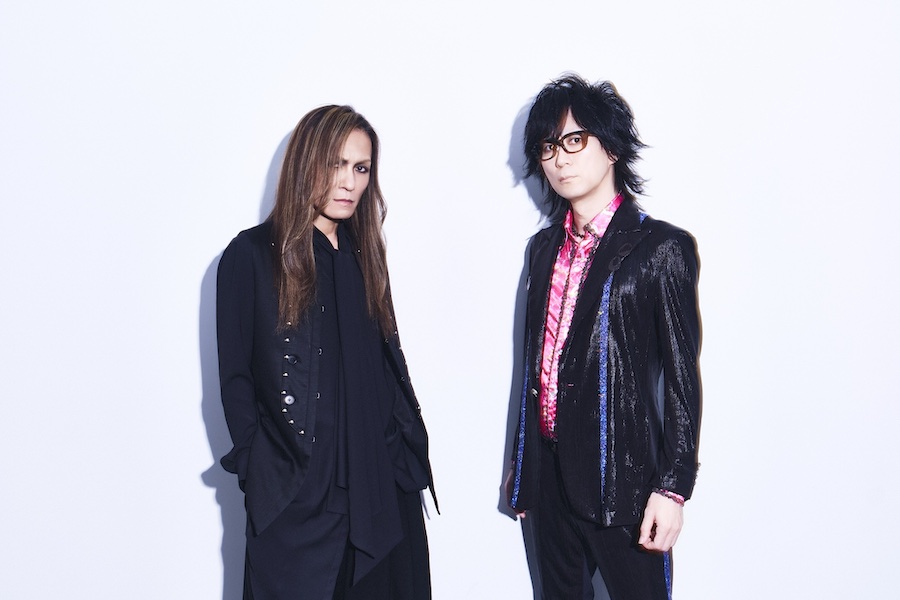
lynch. Reo × Waive Yoshinori Sugimoto: Opposites Attract — "Let's Look at the Same View Together"
This interview was originally published in Japanese on barks.jp. Translated by VK Chronicle.
First-Ever Dialogue: lynch.’s Reo and Waive’s Yoshinori Sugimoto
On December 28, lynch. will complete their series of projects commemorating their 20th anniversary debut, which began in December 2024, with a performance at Tokyo Garden Theater titled lynch. 20TH ANNIVERSARY XX FINAL ACT「ALL THIS WE’LL GIVE YOU」.
After their initial dissolution in 2005, Waive repeated several “revivals” while adopting a status of being “in dissolution,” and then clearly declared their restart for the first time in April 2023. They simultaneously announced their dissolution, and will come to an end on January 4, 2026, with a one-man show at Nippon Budokan titled Waive LAST GIG.「燦」.
What do these two leaders think as they face their bands’ grand stages? The dialogue revealed that their approaches transcend superficial methodology entirely. Though their vectors point in opposite directions, the extremity of their respective commitments converge—it was their individual life philosophies made plain.
◆ ◆ ◆
“There are all kinds of ways, you know? It’s cool.”
Q: lynch. and Waive played together on October 19 at a Waive-hosted versus event 【VS GIGS「LIFE goes音舞美威闘.」】. Did you know each other before that?
Reo: In 1999, when I was in a band called kein at the time—they reunited in 2022—I saw Yoshinori at an event at a venue called UMEDA HEAT BEAT in Osaka. That’s my oldest memory of him.
Q: What kind of conversation did you have?
Reo: We didn’t actually talk at that time.
Sugimoto: I remember recognizing “That’s Reo!” and having a conversation around 1999 too, I think. It was at a live house called BRAND NEW in Nishinokujō, Osaka. We talked right by the wall just inside the entrance. But honestly, I don’t remember why we talked that day or why I was even there.
Reo: My memory’s a bit fuzzy on the exact year, but I went to Osaka to see a one-man show by a band called NEED.
Sugimoto: Then it was 2000.
Reo: I was already close with some of the NEED members, and after the show I went to the after-party with them. That’s when they introduced me to Yoshinori. I definitely remember having that first real conversation.
Sugimoto: That was when they were still called NO NEED, the band before NEED.
Reo: Right, when they were NO NEED. And their one-man set ended in 40 minutes.
Sugimoto: Exactly. That’s when Reo told me “I have a demo tape,” and that was our first conversation.
Reo: A little while later, when Waive wanted to do a show in Nagoya, I introduced them to an event promoter I know. I basically arranged their first Nagoya live. I was a one-sided fan of Waive, so I almost never missed their shows when they played in Nagoya. Yoshinori was generous back then—he’d spend all the charge-back money from shows at the after-parties. “Reo, let’s go get yakiniku!” he’d say.
Sugimoto: The concept was not to save band money.
Reo: We’d go to these insanely expensive meat restaurants, and the grade kept going up as the band made more money. And it wasn’t just the members either. He’d treat all the young guys and everyone who came to the shows too. The music was so orthodox, but what he was doing was so wild. I used to think about that a lot.
Q: Since you were already a fan of Waive, what aspects appealed to you, Reo?
Reo: Even before Yoshinori started Waive, when he was in his previous band, I felt this strong sense of timelessness. Music that wasn’t influenced at all by trends or the times, music you could listen to anytime and think “this is good”—he’s always been providing that. I have this massive admiration for that kind of thing, and Yoshinori has it. I felt he was amazing even back in my twenties, and I wanted to talk to him because I was curious: “How does this person think?” I wanted to understand that. That admiration I had for him then—I still have it now.
Q: And you’re looking to explore that further in today’s dialogue?
Reo: Yeah, that’s right.
Sugimoto: That’s scary laughs. Like I said before, I’m actually a pretty wild character at heart, so there’s a gap between what I do and how I seem. When I first recognized Reo and we met at BRAND NEW, I genuinely thought, “Why do you even like me? We’re doing totally different things. Are you lying?” That was my feeling.
Q: So you couldn’t find common ground?
Sugimoto: There was this senior musician we had in common—YUKIYA, who was doing bands like D≒SIRE and JILS back then. YUKIYA kept telling me about Reo. “There’s this band doing great things in Nagoya, you should definitely listen to them.” But I couldn’t really figure out what drew us together. I’d even think about the NEED shows we both went to: “Why is he coming all the way from Nagoya just to see 40 minutes of their set?” Going out of his way to see some friends’ band for just 40 minutes—I could never do that. Nagoya feels close now, but back then it wasn’t an easy distance to travel. So yeah, I was like “Really? What’s the angle here?” Honestly, I thought of him as someone I just couldn’t understand.
Q: I see.
Sugimoto: Well, I tend to think that way about most people anyway—that their way of thinking doesn’t match mine. So I naturally keep my distance. I put up defensive walls, not completely rejecting them, but not really letting them in either. But then when Waive started expanding beyond Osaka and I thought, “Who should I talk to about this?” the most reliable person I knew in the Tokai region was Reo. Since his twenties, he’s had this character, and musicians around him trust him. I didn’t have connections with Nagoya CD shops or event promoters, so he introduced me to people.
Q: So Reo was instrumental in Waive’s expansion into the Tokai region.
Sugimoto: He probably liked our timelessness, but honestly, in the scene, a band that trades on timelessness isn’t really what people want. It’s a scene where everyone’s competing on individuality, and Nagoya especially has a lot of unique bands. So Waive didn’t get called to play much, and even at events organized in Osaka, there were very few chances to play with Nagoya bands. Among the few connections I had, Reo introduced me to people like aie laughs (deadman, the god and death stars, gibkiy gibkiy gibkiy, kein).
Q: lynch. finishes their 20th anniversary year on December 28 at Tokyo Garden Theater, and Waive dissolves on January 4, 2026, with a Nippon Budokan one-man show. You each have major stages ahead. There isn’t time to recount every twist and turn, but how do you view each other’s band histories?
Reo: When Waive dissolved in 2005, to be honest, I felt like that was the only choice they could’ve made at that time. I can’t quite find the right words, but I could only sympathize with them. Last year, when lynch. played at a MUCC-organized event called 【Love Together】, Tazawa [Waive’s vocalist] came to watch and talked to me. “Reo, long time no talk.” That was right after Waive’s documentary video was released, and when I watched it, I felt this tight pain in my chest. When kein disbanded in 2000, I was in the same situation, so I projected myself onto them.
Q: You couldn’t see it as someone else’s problem.
Reo: I thought “it’s not my place to ask further,” so I didn’t at the time. But it confirmed for me: “Ah, so it really was that kind of atmosphere.” And the fact that they’re bringing it into the light now gives me hope that “it’s not the same situation anymore.” I talked to Tazawa for about 40 minutes about that kind of thing, and I told him, “I’m definitely going to support you.” I could support this dissolution if it’s different from what Waive went through back then. To get to that point—there was COVID, things they’d planned fell through, lots of ups and downs. But honestly, “they’ve brought it this far”—I saw that as truly worthy of respect.
Q: Did Yoshinori know you had that perspective?
Sugimoto: No, not at that stage. But this connects to what led to today’s dialogue. There’s someone we have in common who works at King Records [lynch.’s label]. Through that person as an intermediary, Reo and I exchanged messages for the first time in a long while. And the first thing I got was this text message—so long I thought “Is this a receipt? A novel?” laughs. When we actually met and talked, he conveyed those feelings to me. But how do I put it… it goes without saying, right? We’ve both had comparable careers with different kinds of ups and downs that can’t quite be put into words, but we can imagine the path each other has walked. I think we must have been aware of each other’s activities for over ten years without contact. As for me, I’ve felt both envy and respect seeing lynch. surge forward recently, and in a grand way, it’s been encouragement too. I’ve been shown “oh, there’s this way of doing things.” It’s not like I’m rating my own judgment, but it was kind of like “that guy I thought was amazing way back when? Yeah, he’s still amazing.” Like in horse racing—some horses can only run short distances, others are built for long distances. Humans are the same. Some people benefit from their muscles built up over a long race. “I wonder which kind I am?” That was something I was made to think about.
Q: I’m curious what was in that receipt-length text message.
Sugimoto: I read it, but I had this feeling like even if I hadn’t, we’re probably saying the same thing anyway, aren’t we? I think we really understand each other. And on top of that, I was of course happy that Reo wanted to convey it, because Reo has this personality where he really thinks hard about “how should I communicate this?” If it were the other way around, I’d think “Is me trying to communicate this going to seem lame?” and I’d just hide behind some sticker or whatever. But we can even understand each other in those differences. Our personalities are complete opposites, yet somehow we get each other.
Reo: I poured my heart out trying to communicate my feelings in a line message, and all I got back was a “I’ll beat you up” sticker laughs. I was like, “What does this mean?” But I figured it was Yoshinori’s way of saying “I got it.” The last time we exchanged messages was when I sent an email in 2013 after Yoshinori had voice problems and suspended activities, saying “I’m looking forward to you returning to activity.” So from then until 2025 we had no contact. But we were watching each other from afar. So when I learned that Waive was disbanding and had their Budokan one-man scheduled, I felt like I had to move. I thought “Is there something I can do?”
Q: That led to you appearing on Yoshinori’s streaming show.
Reo: I think “if more people loved what I love, that would make me happy.” Nobody loses in that situation, right? We talked about that, and Yoshinori asked “Want to come on my streaming show?” So I was like “Yes!” Then it became “Should we do a two-man?” and “Let’s do a dialogue,” and here we are today. We did a two-man show in October, and after it ended we talked like “That went this way, and that went that way, and I’d love to see things connect like this. Since we’re here anyway, what do you think about doing a dialogue?” We’ve got our big decisive shows at year-end and new year respectively, so if we could get even one more person to relate to what we’re doing, that would be the best outcome, right? That’s all it is.
Q: That’s unconditional love.
Reo: Is this what unconditional love is? laughs I think of it as my own ego, personally. And I do think I’m the most selfish member of the band. But I try not to say the kind of selfish things that hurt people or tear them down. I figure “if it’s selfish that makes someone happy, then I can say whatever,” and I’ve been doing lynch. with that mindset the whole time.
Q: You mentioned earlier that Waive’s appeal is their timelessness. What kind of appeal do you find in Reo’s music and lynch., Yoshinori?
Sugimoto: This is something I’ve said in interviews too, but I’m not really interested in music, so I don’t particularly feel anything special about musicality or what makes a band good—not just lynch., but generally. Honestly, not even with my own band. But since all music comes from people, it has to be linked to their humanity somehow, right? I’m sure lynch. is the same. And since Reo’s the leader and lynch. is loved, that means Reo’s humanity is loved too, I think. I look at it like “with that kind of character, yeah, that’d get evaluated.” I’m not super close with the other lynch. members, but I’m sure they all have something going for them, which is why things are the way they are. So when people ask “What do you think of lynch.?” I can only answer from a “what do I think of them as people” perspective before anything about the sound or the band itself, and I know that’s probably not the answer people are looking for when written out.
Q: How do you feel hearing that?
Reo: I basically agree. I think music is about who’s playing it and who you’re going to see. Like, even if someone had the same skill as Tazawa and wrote the same melodies, I don’t think it would become Waive’s music. It’s Waive because Tazawa sings it, because Yoshinori, Shoji, and Jun are playing. That’s what it comes down to. A band is, by definition, a collective. So I don’t really think of myself as the leader or the heart or brain of the band—I’m more the person who throws out the topics and brings things together.
Q: On the subject of leadership: you mentioned earlier that you think you’re selfish. But you also have the mission of holding the band together and driving it forward, right?
Reo: Of course. Though “setting goals” might be closer to how I’d describe it than “driving.” If anything, the hard part is bringing people together. The members have strong personalities internally, so when you get conflicting opinions, figuring out how to reconcile them is the challenge. But I do it my own way.
Q: What’s that way specifically?
Reo: It’s not just majority vote. We don’t make a decision until everyone agrees. So sometimes it takes a crazy amount of time, and we just keep exchanging opinions until we reach consensus. Also, I’ll send something in the group chat like “I’m thinking of doing this,” and if people don’t respond, I get mad. But if someone says “I trust your judgment,” that’s fine.
Q: So silence isn’t okay.
Reo: Silence is absolutely forbidden. You have to state your position. That’s part of your responsibility as a member. That’s an iron rule, and it’s always been that way. Beyond that, basically everyone’s free. I leave individual judgment calls to them.
Q: And you, Yoshinori?
Sugimoto: I don’t think I’m capable of exercising leadership, so I’ve never really tried to command. So I basically stake everything on “prove it with results and people have no choice but to follow.” If I just spout theory without the power to make people follow, nothing I say will actually get them to come along, right? “1 + 1 = 2” is easy to understand because the world’s proven it. But if I say “1 + 1 = 3,” people will think “what?” and not follow. The only way is to show them “Look, 1 + 1 = 3” as a result. You do something that seems like magic or a trick, but the result is there, and then they follow the next time. I’ve lived by repeating that, so I’m not changing now. And when it comes to making “