
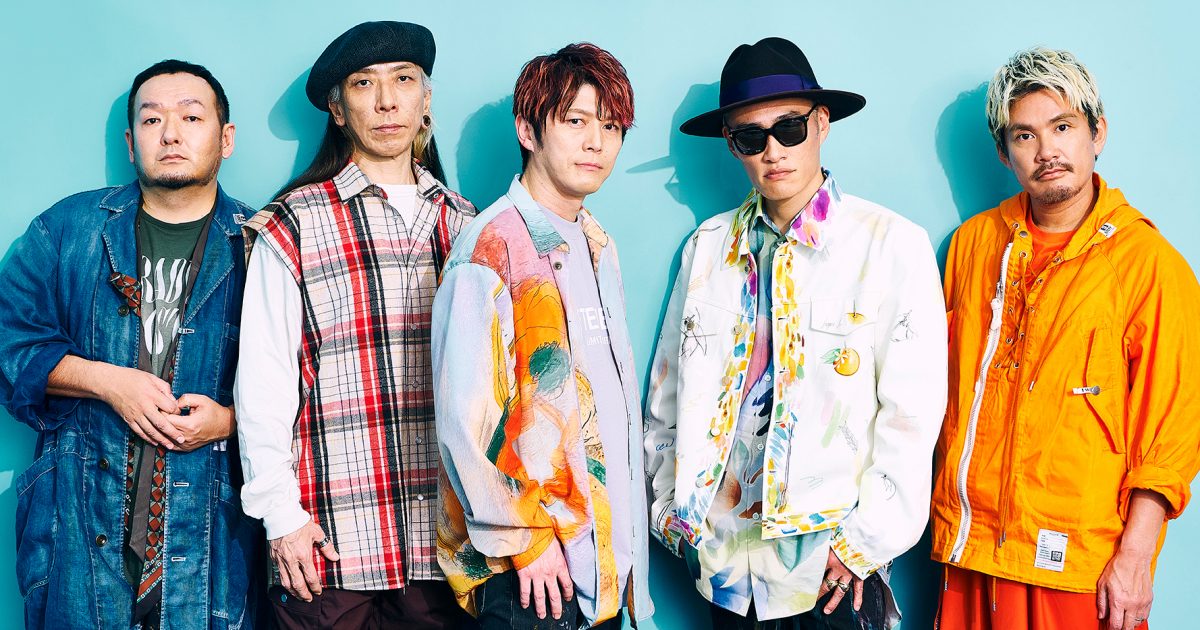
FLOW at 20 Years: The Band's Dramatic Journey and What They Want to Convey Through Their Album Themed on Travel, the World, and Voyage
This interview was originally published in Japanese on thefirsttimes.jp. Translated by VK Chronicle.
FLOW 20th Anniversary Interview
FLOW’s journey began with the massive indie hit “贈る言葉” in 2003 and their major label debut track “Blaster,” and has now reached its 20th anniversary milestone. The band has evolved from mischievous mixture rockers into clever, versatile pop/rock musicians—rising to prominence in the anime song world, touring repeatedly across North America, South America, and Asia, establishing their unique presence. Their latest album Voy☆☆☆ stands as both a culmination of this dramatic journey and a starting point for the next chapter. Let’s hear from all five members as they look beyond their 20th anniversary.
“Things happened over these 20 years that we never imagined. It’s an album that properly brings all of that together”
Q: The 20th anniversary album’s theme is journey, world, and voyage. It really suits FLOW.
TAKE: We’ve been sailing on the FLOW ship for 20 years, and new crewmates have joined us along the way, we’ve reached overseas, and now we’re aiming to conquer all five continents. That’s why we decided on this theme.
KEIGO: “Voy” is Spanish for “let’s go” or “I’m heading out.” It represents the idea that this isn’t the end—there’s more ahead. As COVID is clearing up, we all felt this new beginning vibe, so we wanted to capture that “let’s go” spirit. Also, if you put “age” in the ★★★ spaces, it becomes “Voyage,” which is exactly our album’s theme. And “age” itself represents both 20 years and the time yet to come. Plus, “Voy” has a sound similar to what everyone yells at live venues—”Oi! Oi!” Just recently, we’ve been able to bring back live vocals at our tours, so there’s that connection too. It’s a title packed with different meanings.
Q: Twenty songs total, 21 with the bonus track. I was honestly nervous before listening, but it’s exactly 60 minutes—not overly long.
TAKE: We wanted everything to fit on one CD. In the streaming era, we really thought about what it means to package something physically as a CD. We wanted the experience of listening through the entire album to feel like traveling across all five continents—like the flow of the songs gives it meaning. It starts from Oceania.
Q: That’s the first track, the instrumental “Terminal 1”?
TAKE: It’s a fusion of German metal and Japanese shamisen. I asked GOT’S to make it with a German metal style.
GOT’S: I love German metal. TAKE reworked the guitar phrases into shamisen, and he put it together really well.
“We’ve made albums with all kinds of concepts, but this one has the most variety”
Q: The five instrumentals from “Terminal 1” to “Terminal 5” really become the key to the album. The music progresses with these sounds symbolizing all five continents scattered throughout.
TAKE: It’s like hopping from port to port, airport to airport on a journey. The South American section has bossa nova, Africa has Egyptian-style sounds—it’s a world tour you can enjoy through music.
KEIGO: Including the goal of conquering all five continents, I think all the meaning of these 20 years is right here. When we debuted 20 years ago, we never imagined we’d be doing live shows overseas. Things happened over these 20 years that we never imagined. It’s an album that properly brings all of that together.
TAKE: For casual listeners, there are songs from Code Geass, the Naruto series’ Boruto, a collaboration with Afterglow from BanG Dream!, an anime pachinko song from Eureka Seven—lots of variety. Anime fans should be satisfied with this album too. And for people from Saitama Prefecture, there’s even a song from NACK5’s winter station campaign.
KOHSHI: That’s such a narrow audience (laughs). Just for Saitama residents.
IWASAKI: We’ve made albums with all kinds of concepts, but this one has the most variety. In a good way, the three years of COVID became nourishment—it became part of us. Our approach to music changed so much over those three years. Because of that, we were able to come this far, and we could see the next version of ourselves.
GOT’S: There are songs related to countries we’ve actually visited, and songs imagining places we haven’t been yet. I thought, “Wow, we’ve become a band that can make an album like this.” I want to visit the countries we haven’t been to yet and complete this album.
Q: So Africa and Oceania are the remaining continents?
GOT’S: Yeah. Since we made this, we definitely want to aim for that.
“Absolute losers hanging out and having fun with girls”
Q: And the real highlight is the “贈る言葉” 20th anniversary version on the bonus track. It’s the first re-recording in 20 years, and the music video with Takeda Tetsuya is amazing.
IWASAKI: Facing this song again, I realized that without it, nothing would have started. For a while after the original release, I carried it like a cross. But we got past that, and now we can wield it as a weapon. I think time helped us digest that. We kept the original energy but brought our current skill level, so it’s a more refined, solid performance of “贈る言葉.”
GOT’S: The raw, youthful performance back then had its own charm, right? When we were re-recording, we kept that original vibe but made sure we could show what we’ve gained over 20 years.
KEIGO: In the new music video though, there’s a scene where Takeda Tetsuya and I are watching the original MV together. Looking back at it now… it’s pretty rough (laughs).
IWASAKI: There might be compliance issues with it by today’s standards (laughs).
KOHSHI: Absolute losers hanging out and having fun with girls. That’s why it’s so flaky. You can tell these guys don’t pull in the ladies.
TAKE: The very first shot of our first-ever MV is us getting in a bath with girls in bikinis.
IWASAKI: Someone told us to bring swimwear, and we were like, “Why?” (laughs).
Q: (laughs) No other band like that exists.
TAKE: It was supposed to be a graduation party. After graduation, at night, with no teachers or parents around—just friends having fun together. That’s what we were going for with the concept. But then why do bikini-clad girls show up? (laughs)
IWASAKI: The director was pretty bold about it. Takeuchi Tetsuro.
TAKE: That MV taught us what a music video could be. In “贈る言葉,” there’s a scene where IWASAKI’s playing drums and someone’s feeding him marshmallows. Then in the next song “Melos,” there’s the Marshmallow Cheer Dancers. (laughs)
KEIGO: Who’s supposed to make that connection? (laughs)
Q: That’s perfect. But I do wonder—if you’d kept that wild style going, where would FLOW be today?
KOHSHI: We’d probably be gone (laughs).
TAKE: We’d have become real punk. Out of touch with the times, and constantly running into compliance issues.
KOHSHI: Our spirit isn’t even punk to begin with. It wouldn’t work.
KEIGO: We probably would’ve crashed hard and burned out.
Q: From the moment you chose “贈る言葉,” you were already heading in a different direction from real punk.
GOT’S: Back then, we didn’t know how to get people to come to our shows. We kept inviting only our friends, so we kept thinking, “How do we get more people?” and that’s what led us to “贈る言葉.” It felt like, if we don’t hit a home run with this, there’s no next time. We were fighting for our lives. And it ended up being a massive home run—way more impact than we expected.
TAKE: Around 370,000 copies, I think? The timing helped too.
GOT’S: We got it used as the ending for CDTV (Count Down TV), and that shocked us. Then a week later, “Your Mステ (Music Station) appearance is confirmed!” So… we basically became famous suddenly without really having the skills for it. We still didn’t know how to put on a proper live show. We were desperate. But we could only do what we could do, you know?
“We met Takeda Tetsuya about 20 years ago, and this was our second time meeting—and it was during the actual shoot”
Q: So Takeda, Kinpachi Sensei, was really your benefactor.
KOHSHI: We got to repay that debt with the new music video.
GOT’S: We met him about 20 years ago, and this was our second time meeting—and it happened to be during the actual shoot. We were sitting in the classroom, waiting for Takeda to come in.
KEIGO: We wanted it to feel like a documentary.
TAKE: We only had the story element of presenting him with a commendation, everything else happened naturally on the spot. The tension was incredible.
IWASAKI: When Takeda first started reading the commendation to TAKE, I just felt this rush—goosebumps all over. And then I was nervous the whole time.
Q: “We’d like to give you a diligence award and a perfect attendance award.” It was such beautiful parting words from Takeda to FLOW, perfect for your 20th anniversary.
TAKE: All of this—every bit of it—is history we wouldn’t have experienced without the FLOW ship. And 20 years later, here we are, and we can still see what’s ahead. That’s incredibly fortunate.
Q: I’m sure you get asked this all the time, but what’s the secret to keeping a band going for so long?
TAKE: It’s “continuing to do new things,” I think. Taking on things we haven’t done yet with a sense of freshness.
KOHSHI: From the start, we’ve been doing things we love for these 20 years. As long as we don’t start hating it, we can keep going. And being the five of us making music together just feels the best. It’s obvious, but that’s why we’ve lasted.
KEIGO: In the beginning, I was so caught up in the moment-to-moment stuff that I didn’t understand anything. When we suddenly got famous with “贈る言葉,” I didn’t even know what I was capable of. My role in the band, what I could contribute—that all became clear over time, through experience. Within these five people, when I realize someone else can do what I can’t, that becomes respect. Gradually, we’ve formed a proper pentagon, shaped by experience. I really feel that.
GOT’S: [continuing] Yeah.
“Looking back, it felt like the COVID period. No live shows, activities stopped…”
Q: Speaking of which, what was the hardest time?
KOHSHI: The hardest was when KEIGO had an accident (December 2005, rear-end collision injury). It was our first real setback. I haven’t forgotten that.
TAKE: Looking back, it felt like the COVID period. No live shows, activities completely stopped.
KEIGO: Yeah, it was. Everyone was lost back then.
GOT’S: I wonder why. We could’ve just taken a little break, you know?
KOHSHI: It became way too serious.
IWASAKI: Because we’d been running non-stop. We were in the middle of a tour.
KEIGO: We had to cancel the semifinal and final shows. I just had this overwhelming sense of guilt.
KOHSHI: It’s not my problem—you’re the one who got hurt (laughs).
KEIGO: Right, but the reason was my injury. That’s all I felt at that time.
IWASAKI: [continuing]
TAKE: GOT’S was the first one to go visit me, actually.
KEIGO: Alone.
GOT’S: I got the date wrong. “It’s tomorrow,” right? (laughs)
TAKE: We were thinking the four of us should go together so it wouldn’t be a burden, and he’s waiting… like, “Man, nobody’s coming.”
GOT’S: So I just went by myself. Pretty fancy hospital room too. “Nice place you got here.”
KEIGO: What are you doing here? (laughs) Then he’s like, “Oops, wrong day. I’m out.”
GOT’S: And then I didn’t show up the next day either (the actual planned visit day).
IWASAKI: Wait, we were all supposed to go!
TAKE: It’s crazy we made it 20 years with stuff like this (laughs).
Q: That’s so GOT’S (laughs). But maybe having someone like that in the band is actually the secret to longevity. You don’t really hang onto setbacks or worries, do you?
GOT’S: Not at all. I’m always “it’ll work out somehow” type. That’s how I’ve lived my whole life. For the band to keep going, as long as I’m not dealing with something I hate, I’m fine.
TAKE: The only reason he’d ever quit is…
GOT’S: Bungee jumping and haunted houses. Those are my top two hate-list items. If either of those became part of my job, I’d quit.
TAKE: 20 years of band history losing to a haunted house (laughs).
GOT’S: As long as that doesn’t happen, I’m good. Actually, I wonder how rough things must be for people who quit over other stuff.
Q: Like musical differences or personality clashes?
GOT’S: There must be some serious stuff involved, but I honestly don’t get it.
Q: Please keep going for a long time. As long as IWASAKI can keep drumming.
IWASAKI: Health first. As long as my body can move, I’ll take care of it and keep doing this. I know at our age, we probably can’t keep doing things the exact same way, but we’re figuring out how to compensate elsewhere. I’m having fun drumming right now.
GOT’S: Should we call it when the people around us say so? Like, “IWASAKI, thanks for everything”?
Q: Huh? What are you talking about? (laughs)
KEIGO: You’re not trying to break up the band, are you? (laughs)
TAKE: But technology’s evolving. You could become Mecha-IWASAKI. Drrrrrrr!
IWASAKI: Just my feet becoming mechanical.
KOHSHI: You wouldn’t even be human anymore (laughs).
IWASAKI: I saw a tweet from a drummer in another band yesterday about how someone said Lars from Metallica isn’t a good drummer, but his existence is what matters. Without Lars, it’s not Metallica. That’s the real importance. Maybe it’s like that with us—the five of us coming together as FLOW is what matters.
Q: That’s really it. Seriously.
TAKE: I actually thought about this when we went overseas recently. We were talking about how, in a lot of bands, the vocalist stands out front visually, but someone said “with FLOW, all five members stand side-by-side.” We hear that in Japan too—it’s not like anyone’s standing out. It’s all five of us being FLOW, so it looks balanced. People overseas say the same thing. Maybe it was Mexico?
IWASAKI: Yeah, they did.
TAKE: I think that balance between the five of us is reflected in things like that.
“Our encounter with anime is something we can’t cut away from FLOW—it’s been huge”
Q: That’s the conclusion for these 20 years. So, the album release tour is already underway. The final show is May 11th at Ebisu LIQUIDROOM in Tokyo. And in July, there’s a huge live event worthy of the 20th anniversary.
KEIGO: It’s the biggest place we’ve ever done, and it’s going to be a festival. Our encounter with anime is something we can’t cut away from FLOW—it’s been huge. We’re grateful to every single work, and everyone can enjoy it. Whether people discovered FLOW through anime or through our live shows, these anime songs are also live songs. For the 20th anniversary