
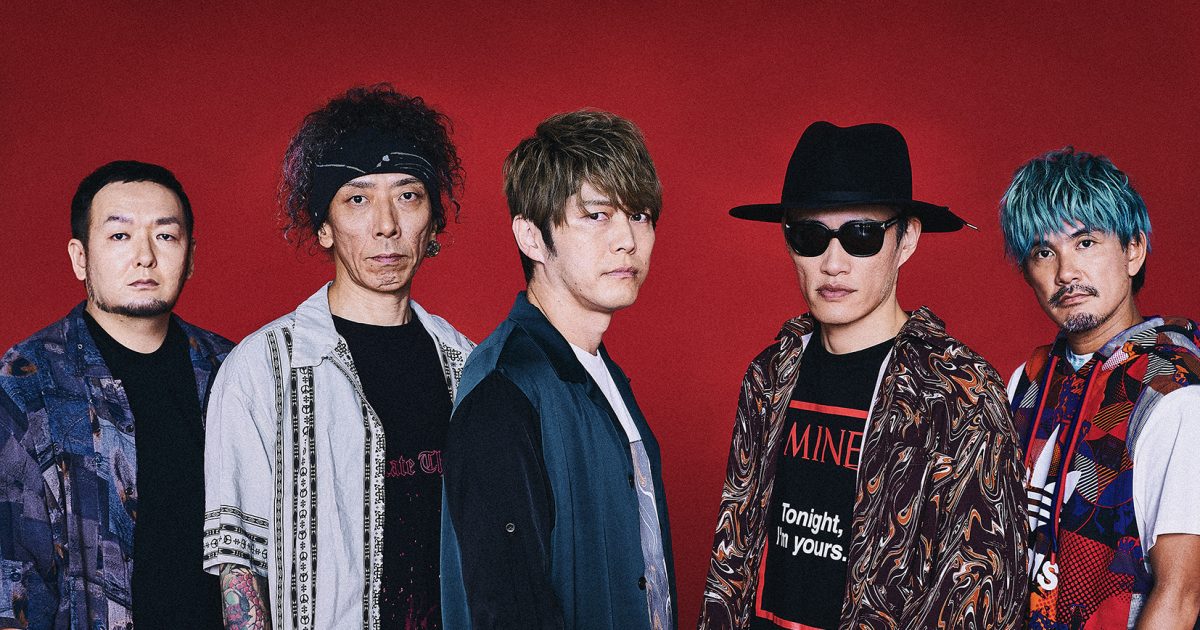
FLOW's First Code Geass Theme Song in 15 Years: "DICE," an Ambitious Work Connecting Past, Present, and Future as the Band Approaches Its 20th Anniversary
This interview was originally published in Japanese on thefirsttimes.jp. Translated by VK Chronicle.
FLOW Interview
“FLOW WINS!” — I just had to shout it out loud. FLOW’s third single of 2021, “DICE,” is packed with three massive tracks that hit hard enough to deserve that kind of enthusiasm. It’s their strongest release yet. There’s “DICE,” the opening theme for the TV anime Code Geass: Lelouch of the Rebellion 15th Anniversary. Then there’s “Victory feat. Afterglow,” a limited-time implementation track for the rhythm & adventure game BanG Dream! Girls Band Party! And “Moment,” an arcade game implementation track for Pachi-Slot ANEMONE Eureka Seven HI-EVOLUTION. With nostalgia in their right hand and novelty in their left, and an unchanging rock spirit burning in their hearts, FLOW steps into 2022 — the anniversary year marking their 20th debut anniversary.
INTERVIEW & TEXT BY Hideo Miyamoto PHOTO BY Yuki Ohashi
■ It’s an honor to be involved with such vibrant work even after 15 years
Q: “DICE” is essentially a self-homage, right? It incorporates elements from “COLORS,” the opening theme for the first season of Code Geass: Lelouch of the Rebellion from 15 years ago, while blending nostalgia with something new.
TAKE: The theme of the work is the same, so including elements from “COLORS” creates consistency, and I wanted both longtime fans and new listeners to enjoy it as FLOW’s current sound. That said, I don’t think we can surpass “COLORS” — there are the memories from back then and what fans are looking for — so we accepted that we probably couldn’t. But as a band that’s grown over 15 years, I thought maybe we could express a new Code Geass opening in a different way. That was our starting point.
KOHSHI: It was genuinely an honor to be involved with such a vibrant work even after 15 years. In a way, it shows how beloved the series is. But knowing we couldn’t surpass “COLORS” created real pressure. The fanbase keeps growing, and people’s love for Code Geass only deepens, so feeling that pressure, I consulted with Director Taniguchi back and forth, making sure our vision aligned before writing the lyrics.
TAKE: Actually, this was the first time I’d talked directly with Director Taniguchi. Before this, we just exchanged emails through intermediaries, so it was all remote. But this time we could speak directly, which was great. The director came up with all sorts of ideas, and we worked to bring them to life as the opening theme for the new Code Geass.
Q: So the relationship with the anime production team got closer than it was 15 years ago?
KOHSHI: Exactly. Fifteen years ago, they just handed us a couple pages with the plot and said, “Ah, so it’s like this,” you know?
KEIGO: Since it’s an original anime with no source material, it just had things like “Lelouch is a character with this kind of setting.”
KOHSHI: So there was no pressure back then. Everyone started from zero together. Of course we wanted to create a good song, but not the kind of pressure we have this time.
TAKE: This time Director Taniguchi was wild — he suddenly said, “I want the sound of a submachine gun at the beginning” (laughs). He wanted to express violence, to include the sound of weapons. Basically, Code Geass is a work about the foolishness of human activity and, paradoxically, celebrating that very moment — it’s a kind of hymn to humanity. Lelouch isn’t perfect either; he struggles and experiments toward his goals. So we put that “da-da-da-da!” submachine gun sound right at the start. Actually, there’s a scene with a submachine gun later in the story, so fans might connect that too. And the singing starts with a chorus imagining the Black Knights, so if “COLORS” was a Lelouch-side song, “DICE” feels more like a Zero song. I think we managed to express that duality across both tracks.
Q: And like “COLORS,” the arranger is Yoshii Tsutaya.
TAKE: When we got this offer, I sent him a direct message right away. I thought it’d be more interesting to do it with the same team as “COLORS.” It’s been forever since we worked with Tsutaya-san — maybe 13 years?
KOHSHI: We only see him on TV these days (laughs).
TAKE: I reached out immediately and said, “This is the kind of song, let’s do it again.” We asked Tsutaya-san to arrange the overlay parts on top of the band sound, and he brushed up my original demo. The live strings sounded so good.
IWASAKI: I also thought surpassing “COLORS” would be incredibly difficult, so what if we approached it as like… brother songs? If “COLORS” is the older brother, then “DICE” is the punchy younger brother — the kind that’s got a bit of the older brother’s face in him (laughs). Once I could see that landing point, it was pretty easy to work with.
Q: Your rhythm section is intense. You’ve got different rhythm patterns coming one after another — barely time to breathe.
IWASAKI: It’s tough (laughs). But it’s fun to play.
Q: Honestly, I just had to say “Iwasaki wins!”
IWASAKI: Should we move on to the second track?
■ Can you swallow the parts you don’t want to show and become a bigger person?
Q: I just had to say it (laughs). So the lyrics are written from Zero’s perspective, Kohshi?
KOHSHI: Yeah. If it were the old FLOW, at the end of the chorus where it says “stand with darkness before the light,” we probably would’ve sung “stand with light before the darkness.” But from Zero’s position, it’s reversed. I wrote it capturing Zero’s mindset — he has to fight the light with darkness. But there’s also this theme of “can you embrace both purity and murkiness?” It’s asking: can you swallow the parts of yourself you don’t want to show and become a bigger person? That’s what I meant by “stand with darkness before the light.” I was writing it thinking, man, Zero carries all that darkness alone — he’s incredible. But also thinking, I could never do that.
Q: Is the title “DICE” from the famous phrase “the die is cast”?
KOHSHI: Exactly. In English, “the die is cast” — die being the old form of dice. Apparently it’s a phrase uttered by an ancient Roman general to boost his army’s morale, and I thought that really overlaps with the Black Knights, so we went with “DICE” as the title.
■ I figured we could sing together in a more straightforward rock style
Q: Shall we move to the second track? “Victory,” a collab with BanG Dream! Girls Band Party! Your duet partner is Ayane Sakura, who voices Ran Mitake of the band Afterglow.
TAKE: Sorry for putting a guy in Girls Band Party! (laughs) Now it’s basically Boys Band Party. Or maybe it’s not even that anymore.
Q: It’s the kind of straightforward mixture rock that screams FLOW.
TAKE: We listened to Afterglow’s songs beforehand, and they have quite a few tracks in a straight rock style — like “Y.O.L.O!!!!!” So we thought, with this kind of vibe, we could sing together in a more straightforward rock approach, like FLOW’s “Re:member.” That’s where I started composing from.
KEIGO: The back-and-forth between three of us was fun. Sakura-san sings so coolly, but when I asked her about it, she said she adjusts to match the character’s voice.
TAKE: I thought it was amazing how she layers the character onto her singing, but apparently she can’t sing without doing that — she said she doesn’t know what she sounds like singing normally. “You musicians are incredible,” she told us.
KOHSHI: We don’t have anyone telling us to “put character into it” or anything (laughs). I think what she does is more impressive.
GOT’S: “Victory” turned out great. I’ve been really into four-string bass lately, and I can definitely feel the difference. Because the range is narrower, where I used to naturally go low, I’m now choosing not to use that space, which is actually interesting. “DICE” is also on four-string bass, and there’s a reason for that. During the recording of “COLORS,” I got called out by Tsutaya-san for using a drop-tuned bass. He said the instrument wasn’t resonating properly.
TAKE: Right, you had to change the tuning on the spot.
GOT’S: Yeah, and I had to re-learn all my fingerings — it was traumatic (laughs).
TAKE: All the patterns you’d memorized had to change.
KEIGO: That would definitely be traumatic.
GOT’S: So this time around, I was thinking, I can’t mess up the same way. I decided not to use a five-string bass and stick with four-string. I actually went out and bought a new four-string bass, though in the end I recorded with my Fender that I already had. I was really focused. We do this thing called “reamping” where we record at home and then do the final sound design at the studio. I was nervous showing it to Tsutaya-san, but he said “that’s good,” and I was like, “Oh man, thank god!”
I recorded “Victory” on four-string bass too.
TAKE: But we had another moment this time, right? On the final chorus of “DICE,” I went higher to build it up, and then…
GOT’S: Tsutaya-san said, “That high part — we don’t need it” (laughs).
TAKE: That’s because when bass plays in the high register, it does create a build, but the low end disappears. I didn’t like that, so I suggested cutting it.
GOT’S: Right up until the end, there was that tension. It felt like being tested.
■ We were completely caught up in the Olympics
Q: The lyrics to “Victory” are a passionate call-and-response among the three of you, a straightforward cheering song.
KOHSHI: I was writing it right in the middle of the Olympics, and I was completely swept up in it. I saw athletes crying after winning gold medals, saw the coaches and staff supporting them, and it really moved me. I wanted to include that feeling. And since Afterglow and FLOW have something in common — we’re both bands — I thought it’d be good to write about how we’re here now because we have bandmates we’ve shared joys and hardships with. That’s how “Victory” came about.
Q: “Victory” is internet slang, right? I only recently learned about it myself.
KOHSHI: I didn’t know about it until a few years ago either, but after appearing at anime events, people would tweet things like “FLOW wins!” and I was like, “Oh, that’s how you use it?” (laughs) So I thought, why not use it now.
TAKE: I honestly thought we’d get absolutely ripped apart online for putting boys into Girls Band Party! But surprisingly, people were cool with it. They were like, “Afterglow and FLOW together makes AfterFlow — that’s a winning situation!” It’d be cool if this could expand in all kinds of ways.
KOHSHI (Vo)
Q: Sounds promising. And the third track is “Moment,” an implementation track for Pachi-Slot ANEMONE Eureka Seven HI-EVOLUTION.
TAKE: Honestly, this single is a real hodgepodge. We’ve got the Code Geass anime, the BanG Dream! game, and Eureka Seven pachinko. It’s very diverse.
KOHSHI: It’s like a bento box lunch with all different compartments.
GOT’S (Ba)
■ Believe it will bloom someday, don’t forget you will die, and work hard now
Q: “Moment” evokes that earlier “DAYS” — it’s another song with strong self-homage elements.
TAKE: We featured the congas we used in “DAYS.” This time the main character is Anemone, who appears in the movie (Eureka Seven HI-EVOLUTION Part 2), so while our earlier “DAYS” and “Brave Blue” were completely from Renton and Eureka’s perspective, this time we could approach it from a different angle.
KOHSHI: The anemone flower blooms in spring after surviving the harsh winter, so I wrote it using that as a metaphor. “Moment” actually carries two meanings — moment in the sense of a single instant, and memento mori — the idea that you will surely die and must not forget it. I layered those two meanings together. The message is: believe that you will bloom someday, don’t forget that you will die, and work hard right now.
Q: The arrangement keeps the dance-rock feel from “DAYS” but updates it, right?
IWASAKI: Situationally it’s similar to “DICE” — there’s “DAYS,” the older brother, and then “Moment,” the younger brother. If “DAYS” had never existed, I don’t think we would’ve gotten into four-on-the-floor dance rock in the first place. That was a turning point for us. More than 10 years later, I wanted to pull something deeper out. So I intentionally simplified things, made subtle differences. It’s the same four-on-the-floor, but it’s “this is how we’d do it now” — that’s “Moment.” Because I could see that endpoint within myself, the completion actually came pretty quickly.
IWASAKI (Dr)
■ I think we’ve gained a lot in these 19 years
Q: I wonder if, while you’re updating the sound, the sound is also updating you — through being in FLOW.
TAKE: When all you’ve played is American hard rock! (laughs) “Dance rock? What’s that?” he said.
IWASAKI: Back then, I was totally like that.
TAKE: Now it’s “Soca rhythm?” or…
Q: Drum and bass?
IWASAKI: And it all gets mixed into a single song.
Q: That’s exactly what “DICE” is — it’s got everything.
IWASAKI: Right! And I’m like, is that what happens when time goes by?
TAKE: It’s 15 years of accumulated experience. Or we should say 19 years since debut.
IWASAKI: I do feel like I was nurtured in a way. If I hadn’t done those kinds of things back then, I might’ve already quit. In that sense, I think I’ve gained a lot over these 19 years. Same with “Victory” — it’s like a signature song for us, but I realized we can’t survive on just that. So we listen to what younger bands are doing in party rock, and we incorporate ska rhythms from what’s cool right now.
■ “We’re not fading away here!”
Q: FLOW keeps evolving. This single meaningfully connects past, present, and future.
TAKE: This is a single we could only make after 19 years of continuing.
KEIGO: It’s amazing that at this timing, both Code Geass and Eureka Seven — works we got to be involved with over 10 years ago — are coming back with new requests. The last two years have been so negative because of COVID, but thinking “as a band, is there something new we can do?”, we did 12 Months of Flame (a series of monthly streaming concerts from September 2020 to August 2021, each with a different album concept). We thought, “Let’s not look down, look forward, and do what we can now.” And when these works that haven’t faded after 15 years — that have actually gained even more momentum — ask us to create music, we get encouraged by it. It felt like the perfect timing for, “We’re not fading away here!”
TAKE: And having new content like BanG Dream! come in too is really something to be grateful for. This single has a “FLOW × Code Geass Edition” (limited production version) that compiles songs FLOW has written for Code Geass, so fans of the series can enjoy them all together. The live footage from 12 Months of Flame is also getting its first release here.
**